Showing posts with label psychedelia. Show all posts

Wednesday, September 11, 2013

Breaking Open the Head: Michael Hollingshead, the World Psychedelic Center, and Self-Trepanation - the Alternative Lifestyle Choice that Never Took Off.


This story is made up of a couple of curious and eye-opening foot-notes to the history of psychedelia.  My sources are Storming Heaven by Jay Stevens, Turn Off Your Mind by Gary Lachman, and some webpages that I'll link at the bottom.

In 1970, Amanda Feilding, the Countess of Wemyss and March, then aged 23, put on a bandana and went to eat a steak in a restaurant near the Chelsea embankment, London.  Feilding was tucking into her steak in order to replace the blood she had recently lost - by boring a hole in her skull with a dentist's drill.  The operation had been filmed by her boyfriend Joey Mellen, to be used in a documentary called Heartbeat in the Brain.  To elaborate on the milieu out of which this bizarre London evening emerged, we will divert to the life and times of another man who opened his mind - this time with a mayonnaise jar which would become the stuff of legend.

         Michael Hollingshead outside the Harvard building were he turned Timothy Leary on to LSD.

In 1960, Michael Hollingshead was an expatriate Englishman with a slightly shady reputation, living in New York and working in some kind of capacity for the British American Cultural Exchange Institute.  One day, a small package arrived from the Sandoz corporation in Switzerland, containing one gram of LSD, roughly five thousand hits.  (Hollingshead became interested in LSD after reading Huxley and experimenting with mescaline, and claimed he had persuaded a doctor friend to write the request for the acid on a hospital letterhead, ostensibly for the purpose of some kind of bone marrow experiments.)   He decided to mix the acid with water and confectioner's sugar, and store the whole fiendishly potent stash in a sixteen-ounce mayonnaise jar.  The problem was that Hollingshead had been carelessly tasting the mixture with his finger as he worked on it, later estimating that he'd unconsciously absorbed 5 strong doses of pure Sandoz before screwing the lid on the legendary jar for the first time!  He went off on a 15 hour trip from which he never fully returned:  "It was a very strange first trip indeed, and it was of many hours' duration, perhaps fifteen. What I had experienced was the equivalent of death's abolition of the body. I had literally 'stepped forth' out of the shell of my body, into some other strange land of unlikeliness, which can only be grasped in terms of astonishment and mystery, as an état de l'absurde, ecstatic nirvana. I could now 'understand' why death could produce the sort of confusion I was experiencing. In life we are anchored through the body to such inescapable cosmic facts as space, gravity, electromagnetic vibrations and so forth. But when the body is lost, the psychic factor which survives is free to behave with uninhibited extravagance."  (The Man Who Turned On the World, 1973.)


 On Huxley's advice, Hollingshead packed up his mayonnaise jar and headed for Massachusetts to seek out Leary.  The rest is fairly well-documented history: Leary had been on a kind of collision course with the straight, middle-class world for some time, but in the shattering nirvana of his first acid trip, the Harvard professor finally got off the boat and split from the whole fuckin' programme for good.  Everything was revealed to be a tawdry television-set, and like the WS Burroughs of Nova Express, Leary felt compelled to Storm the Reality Studio and Retake the Universe.  An anarko-hedonistic-egotist was born.

At the back of all this, Hollingshead's role as Leary's lysergic Svengali is somewhat murky.  There is the palpable air of a dark magus about him, the air of somebody who found anything but the Light on the Other Side of the Rainbow.  According to Lachman in Turn Off Your Mind:  "Hollingshead would get a reputation as a real demon of a psychedelic guide, spiking people with massive doses, or leading trippers down convoluted paths and then abandoning them....his penchant for manipulation, lying, and coercion are clear signs that he was basically interested in power.  Like Charles Manson and the CIA, Hollingshead 'grokked' LSD's potential for mind control."  At first falling at his feet like a student to his guru, Leary eventually wearied of Hollingshead's disruptive presence, and sent him to London to proselytize the acid revolution on his home turf.  Like Johnny Appleseed-cum-John the Baptist, Hollingshead set sail with another gram of LSD and thirteen boxes of psychedelic literature, quickly establishing a apartment, 21 Pont Street, Belgravia as "The World Psychedelic Center."

 The location of Hollingshead's Psychedelic Center (picture from The Great Wen blog.)

All serious misgivings about Hollingshead aside, the World Psychedelic Center sounds like a hell of a scene while it was was going; basically the ultimate chill-out zone with quasi-religious overtones.  The place was decked out with cushions and candles everywhere, a projector that showed slides of mandalas and Hindu deities and Bodhisattvas, a sound-system that played Ravi Shankar and John Cage space music and wild Moroccan pipes (and the ubiquitous Bardo or two, of course)....the ceremonies usually began at midnight, when grapes laced with 300 micrograms of acid were passed around.   I don't know who actually cleaned the place up, but I could definitely imagine curling up of an evening in 21 Pont Street.  Unsurprisingly, with acid in London in relatively short supply during this period, the World Psychedelic Center became a mecca for serious scenesters and a nexus point of hip London royalty and avant-garde notoriety.  During its short lifespan, Roman Polanski, Paul McCarthy, Eric Clapton, the Stones, Donovan, Burroughs, Alex Trocchi, and many others passed through, sampling the grapes and opening fourth, fifth and sixth eyes.....what a scene.  Fuck Clapton, though.

Needless to say, a visionary, Eleusinian speakeasy like this couldn't stay in business for the long haul.  For one thing, the host was gradually turning into a scarily drug-fried zombie of the highest order: "Hollingshead himself was increasing his drug intake to incredible levels, soaking his nervous system in hashish, methedrine, acid.  He never slept, and shocked himself out of a zombie-like walking coma with injections of dimethyltriptamene, a fast-acting psychedelic." (Lachman, Turn Off Your Mind.)  Yikes.  Eventually busted for possession of an ounce of hash, Hollingshead elected to defend himself, while dosed on acid.  The story just keeps on giving.  Sent down for 21 months to Wormwood Scrubs, Hollingshead receives a batch of acid from visitors Richard Alpert and Owsley Stanley, and decides to turn on his cellmate.....who turns out to the English double-agent and KGB-aiding traitor George Blake......who naturally enough freaks out, thinking Hollingshead is a spy.  Blake eventually escaped from Wormwood Scrubs with the aid of two anti-nuclear protestors, and fled for the USSR; Hollingshead's next port of call was the Scottish island of Cumbrae were he hung out with an acid cult for a while (assumedly no virginal constables were sent from the mainland to harsh up the scene)  before embarking on some globe-trotting.  Anyway, that's all I know of Hollingshead's story; let's bring it back to the gruesome head-trip we started at.

                                           Bart Huges Breaking Open the Head in 1965.

Just about every adult in the world must have an acute sense at some time or another of how much fresher, richer, and more expansive were their consciousness and perceptions when they were children, how much slower time seemed to move, and how more novel and interesting everything appeared.  In fact, we devote a great deal of time and energy to trying to restore this prelapsarian vivacity of consciousness,  this condition which Huxley in The Doors of Perception called "the perceptual innocence of childhood, when the sensum was not immediately and automatically subordinated to the concept", whether it be via drugs or sex or absorption in the heightened emotional landscapes of movies and music, or anything that might puncture the comfortable numbness of adult perception.  But all these restorations are only temporary; you can't stay high forever.  During the early sixties, a Dutch librarian turned medical revolutionary named Bart Huges thought he had found the answer to this perennial  problem - and it wasn't pretty.  Trepanation is the practice of drilling a hole in the skull, normally as a surgical procedure designed to alleviate some mental or inter-cranial illness.  It is in fact one of the oldest surgical procedures for which we have archeological evidence, and it was practiced all over the world.  Huges, however, came to believe that trepanation could restore the lost vivacity and intensity of childhood perception - could in effect "cure" the debilitating illness of adulthood - by increasing the flow of blood in the brain.  He was so convinced of his thesis that he performed the operation on himself, eventually unveiling the results to a crowd of hip cats at an art happening in Amsterdam in January of 1965.  According to John Michell in Eccentric Lives and Peculiar Notions "Babies are born with skulls unsealed, and it is not until one is an adult that the bony carapace is formed which completely encloses the membranes surrounding the brain and inhibits their pulsations in repsonse to heart-beats. In consequence, the adult loses touch with the dreams, imagination and intense perceptions of the child. His mental balance becomes upset by egoism and neuroses. To cure these problems, first in himself and then for the whole world, Dr Huges returned his cranium to something like the condition of infancy by cutting out a small disc of bone with an electric drill. Experiencing immediate beneficial effects from this operation, he began preaching to anyone who would listen to the doctrine of trepanation. By liberating his brain from its total imprisonment in his skull, he claimed to have restored its pulsations, increased the volume of blood in it and acquired a more complete, satisfying state of consciousness than grown-up people normally enjoy".

Huges, then, believed himself to be a self-mutanted child of the New Aeon; as he wrote in his manifesto Homo Sapiens Correctus, "Gravity is the enemy - the adult is its victim - society is its disease...I think that no construction of adults can work optimally unless each adult in the construction has been trepanned."  Needless to say, trepanning didn't quite take off with the same intensity as Leary's proselytizing on LSD's behalf - indeed the first response of the Dutch authorities to Homo Sapiens Correctus was to place Huges in a mental hospital.  But Huges did find a disciple in the form of Joey Mellen, who would become one of Hollingshead's main partners in the World Psychedelic Center.  Mellen first met Huges in Ibiza, and became so impressed by the trepanning philosophy that he eventually secured the fiances to bring Huges to London and set him up in a Chelsea flat.  (Where did these cats get all the bread for setting people up in flats from?)  Polanski and Clapton weren't lining up like they had been for Hollingshead's grapes, and a Sunday newspaper rather uncharitably suggested THIS DANGEROUS IDIOT SHOULD BE THROWN OUT.  Nevertheless, Mellen eventually followed in the footsteps of his master.  Unable to persuade any medical professional to perform the operation, he was forced to do it himself.  After a couple of grisly botched attempts - undertaken while under the influence of LSD....YIKES - Mellen finally performed the operation successfully.  (His partner Amanda Feilding followed him in 1970 in the circumstances described above.)  Joey Mellen documented his experiences in a kind of Doors of Perception for the drill-bit set called Bore Hole; its first line is up there with Call me Ismael:  "This is the story of how I came to drill a hole in my skull to get permanently high."


. “Gravity is the enemy. The adult is its victim – society is its disease…I think that no construction of adults can work optimally unless each adult in the construction is trepanned. - See more at: http://www.madscientistblog.ca/mad-scientist-6-bart-huges/#sthash.f52z9n27.dpuf
Well, that's tonight's episode.  Are Joey Mellen and Amanda Feilding courageous mutants, harbingers of a new, free-floating and permanently childlike consciousness?  Or just suggestible people who followed the yearnings of a strange time for transcendence from the tedium of the adult world to a gruesome and insane extreme?  Whatever the answer, don't try any of this at home - except maybe mayo.

Secret London: LSD Experiments at the World Psychedelic Center.

The People with Holes in their Heads by John Michell.

Mad Scientist 6: Bart Huges.


Monday, September 9, 2013

LSD: LETTWIN V. LEARY (MIT, 1967)

On May 3rd, 1967, Timothy Leary, in the height of his Marshall McLuhan-coached High Priest phase, debated psychiatrist and neurosurgeon Dr. Jerome Lettvin in MIT.  The debate was televised by WGBH -TV, gaining some notoriety for Lettvin's use of the word "Bullshit!"  Leary's performance is sometimes inspiring and incisive, and sometimes glib and rambling; Lettvin is certainly an energetic critic of Leary's hedonistic gospel.  A very entertaining cultural artifact of its time:


Thursday, August 22, 2013

Religion Was Being Born/Down in Monterey: DA Pennebaker's Monterey Pop (1968)


The Monterey International Pop Music Festival of June 1967 has been somewhat eclipsed in the collective memory banks by the other big rock festivals of that decade: the "biblical, epical" scene of Woodstock so thoroughly documented in Michael Wadleigh's brilliant movie of the same name, the apocalyptically grim vibes and tragedy of the Altamont Free Concert, and so on.  But Monterey was the precursor of all the big rock festivals, a truly seminal event that captured the countercultural wave in it's first full, giddy ascent.  Monterey introduced Jimi Hendrix, the Who, Ravi Shankar, Laura Nyro, and Janis Joplin to a wider US audience for the first time.  Hendrix' set famously culminated in the destruction of his guitar by fire, in a performance at first blatantly sexualized and then solemnly religious; Columbia Records immediately signed Janis Joplin on the basis of her performance with Big Brother and the Holding Company.  At the behest of George Harrison, Ravi Shankar played before a western audience for the first time, and Hugh Masekela and Otis Redding also got to do their thing before a larger, whiter crowd than ever before.  Woodstock was on a much larger and more confrontational scale, but for many, Monterey easily trumps its iconic bigger brother in terms of music and performance.


A movie of the Monterey festival was shot by verite wizard DA Pennebaker.  Pennebaker had already impressed Jean-Luc Godard with his documentary of the 1960 Wisconsin Primary between John F Kennedy and Hubert Humphrey, and created an intimate and surreal portrait of Bob Dylan in the maelstrom of his growing fame and lionization in Dont Look Back.  Pennebaker described his approach towards filmaking as "records of moments", "half soap operas", and "semi-musical reality things".   It hardly needs to be said that Pennebaker could shot the shit out of a concert, and that's exactly what he did here.  I recently discovered a full upload of Monterey Pop on youtube, and was knocked out by almost all the performances.  I'm going to link to the film on youtube below, but as a teaser, here's Eric Burdon and the Animals' propulsive and catchy celebration of the event in song:


You can watch Monterey Pop on youtube here.  Get it while it's hot - it mightn't be there forever.

http://en.wikipedia.org/wiki/Monterey_Pop


Wednesday, August 7, 2013

Doctor Ilusion and Contact the Star People: Two Films by Larry Carlson.


Larry Carlson is a very eclectically talented multi-media artist who produces DEEPLY trippy audiovisual collages.  His best work fuses cartoons, found ephemera, washes of psychedelia, and metaphysical schlock into what feels like a full-on deep-sea dive into the collective unconscious.  Here are two video art pieces to give a you a taste of his work; the second, Contact the Star People, is probably my favorite.


Visit THE WONDERFUL WORLD OF LARRY CARLSON HERE.


Monday, July 22, 2013

The Mind-Bending Visionary Art of Mati Klarwein.


I was aware of Mati Klarwein's work though its use as iconic cover art for Bitches Brew, but never put a name to the artist until recently.  Klarwein was born in Hamburg, Germany in 1932, and studied art at the Ecole des Beaux-Arts, eventually encountering something of a mentor figure in Ernst Fuchs in Saint-Tropez.  After travels in various far-flung places from Tibet to North Africa, Klarwein washed up in New York city in the early 60s, where he befriended Jimi Hendrix.

Although he did experiment with a little with LSD, Klarwein claims that psychedelic drugs had a minimal influence on his art.  Indeed, the Force was naturally so strong with Klarwein that he may have been the only person in history whom Timothy Leary thought DIDN'T need psychedelic drugs.  Looking at his work, I'm inclined to agree with that diagnosis.  Klarwein's artwork experienced wide exposure during the 70s, especially after Miles Davis commissioned him to design the cover for his fusion masterpiece Bitches Brew.  In this surreal and hilarious interview, Klarwein describes his entry into the weird headspace of the Milesverse circa '69 (listen here.)

Klarwein passed away in 2002.   His webpage has a fantastic selection of otherworldly gems to browse through, and is well worth a trip - Mati Kerwwein Website.  (Click images to enlarge.)


via feuilleton

Friday, May 3, 2013

Towards the Visionary Antipodes of the Human Psyche: Clark Ashton Smith and H.P. Lovecraft Anticipate the Psychedelic Experience.


           There was a strongly exciting sense that my knowledge of past (or present?) reality was enlarging pulse by pulse, but so rapidly that my intellectual processes could not keep up the pace.  The content was thus entirely lost to retrospection - it sank into the limbo into which dreams vanish as we gradually awake.  The feeling - I won't call it belief - that I had a sudden opening, had seen through a window, as it were, distant realities that incomprehensibly belonged with my own life, was so acute that I cannot shake it off today.

              William James.

             And it is precisely this which gives them their numinous quality, their power to transport the beholder out of the Old World of his everyday experience, far away, towards the visionary antipodes of the human psyche.

              Aldous Huxley, Heaven and Hell.

            So when I learned of the drug which would unlock the gate and drive me through, I resolved to take it when next I awaked.

              H.P. Lovecraft, Ex Oblivione.

"Dream of flying over a city."

              I've never really subscribed to the commonplace that H.P. Lovecraft was a bad writer redeemed by a prodigious imagination.  To me, this view feels predicated on a narrow sense of what good prose or good writing should be like.  Gene Wolfe once said that the essence of good writing lies in matching the right style, register, or "voice", to the specific type of story being told.  By this criterion, it is difficult to find fault with Lovecraft as a stylist.  His distinctive literary voice - sounding somewhere between a carnival barker luring you into a darkened tent, a gibbering madman whispering quasi-scientific delusions in your ear, and an arch spoofer who is completely in on the joke - fits the weird contours of his fictional universe like a glove.  Lovecraft as a prose writer is like Vincent Price as an actor - we find them completely believable because their camp artifice is perfectly attuned to the ambiance of the world into which it is embedded.

           A reasonable argument might be made, however, that Lovecraft's work has enjoyed a pervasive cultural resonance and influence which somehow exceeds his abilities and accomplishments as a writer - that it possesses some peculiar x-factor which elevates it above the work of other more technically skilled writers.  The most common explanation offered for this x-factor is that Lovecraft's work embodies a consistent philosophical worldview, and might be construed as offering a mythic cosmology for a materialistic, post-religious era, or, more paradoxically, a myth-cycle for an era for whom the world can no longer be organized according to myths.  According to this view, the value of Lovecraft's work lies in its imaginative articulation of what Teilhard de Chardin called the modern "malady of space-time", the "feeling of futility, of being crushed by the enormities of the cosmos." (The Phenomenon of Man.)  This certainly articulates the difference between Lovecraft and his great contemporary Clark Ashton Smith.  Smith was a better prose writer and poet than Lovecraft, but his work tended towards a purer, more lush and visual type of fantasy.  This argument doesn't seem entirely convincing, though.  Arthur Machen and Algernon Blackwood also expressed a philosophical worldview in their stories, and yet they have not enjoyed the enduring cultural fascination of the Providence misanthrope.  Also, if the primary value of the work lies in its articulation of a despairing, nihilistic philosophy of modern materialism, why has it proven so appealing to hardcore occultists like Kenneth Grant and Alan Moore?


             Lovecraft is one of the few iconic authors in the weird fiction/fantasy realm that I am aware of who was also, at least on the surface, an atheistic materialist.  The two things do not immediately go together.  Most really great authors of fantastic literature, I think, have a kind of Platonic attitude towards the realm of the imagination - they tend to regard the imagination as being of equivalent or even superior importance to the material realm.  This is natural enough.  You wouldn't spend your professional career underwater unless you thought there was something down there.  Most of Lovecraft's most significant influences - particularly Machen and Blackwood - were mystics who regarded their weird fictions as an expression of how they thought the world really was.  In Lovecraft, however, we find the paradox of a materialist who chose to express his cosmic philosophy for the modern scientific epoch by means of a mythopoeia of ancient gods and resurgent atavisms, and who found his ideas and images more in the manner of a shaman than a scientist.  The real x-factor in Lovecraft's work, I think, is that he was a visionary writer.  I mean visionary in this context to denote the type of artist who does not seen to create alternative realities, but rather to describe them.  Although perhaps a little difficult to nail down in concrete terms, this is a characteristic that we instantly recognize.  The ordinary or even highly accomplished artist toils to create scenarios involving things they have invented or using preexisting archetypes which have come down to them from other artists, but the visionary seems to see things which are not immediately associated with their own personalities or personal histories.  Discussing psychedelic and visionary states in his essay Heaven and Hell, Huxley expresses this sense whereby the truly visionary experience does not seem to derive from our own subjective selves and personal histories:

          "Almost never does the visionary see anything that reminds him of his own past.  He is not remembering scenes, persons or objects, and he is not inventing them; he is looking at a new creation.  The raw material for this creation is provided by the visual experiences of ordinary life; but the molding of this material into forms is the work of someone who is most certainly not the self who originally had the experiences, or who later recalled and reflected upon them.  They are (to quote the words used by Dr J. R. Smythies in a recent paper in the American Journal of Psychiatry) 'the work of a highly differentiated mental compartment, without any apparent connection, emotional or volitional, with the aims, interests, or feelings of the person concerned.'"

           One of the most intriguing qualities about Lovecraft's work is the strangely obsessive and consistent quality of his visions, which we know to be largely derived from his dreams; the obsessive reiteration, for example, of aerial visions of gigantic, antediluvian architectures.  The Call of Cthulhu famously suggests that the dreams of artists, poets, and the insane possess a peculiar consistency and sensitivity to perturbations of the cosmic ether; this faculty is notably absent in men of industry and scientists:

           "These responses from aesthetes told a disturbing tale.  From February 28th to April 2nd a large proportion of them had dreamed very bizarre things, the intensity of the dreams being immeasurably the stronger during the period of the sculptor's delirium.  Over a fourth of those who reported anything, reported scenes and half-sounds not unlike those which Wilcox had described; and some of the dreamers confessed acute fear of the gigantic nameless thing visible towards the last."

            Lovecraft was clearly haunted and preoccupied by the visions he experienced in dreams.  A sizable percentage of his work (the Dunsany-influenced pieces) directly concern dreams and dream-quests.  His journals and commonplace books are littered with references to dreams, and the story Celephais was occasioned by a dream which he describes thus: "Dream of flying over a city."  The first paragraph of the very peculiar prose poem Nyarlathotep was apparently written while the author had not fully awoken from the dream which inspired it. In his annotations to the Complete Fiction, S.T. Joshi also notes a very intriguing entry: "Man journeys into the past - or imaginative realm - leaving bodily shell behind."  First of all, the association of the dreaming mind, the imagination, and the deep past is a pregnant one in the light of Lovecraft's fictional obsessions, and the second half of the quote has a peculiar savor of Platonic mysticism to it, considering the author's putative materialism.  We thus find in Lovecraft a bundle of contradictions - an obsessive visionary who publicly regarded his stories as errant but entertaining nonsense; an antiquarian and anti-modernist who wrote about antediluvian terrors and horrifying atavisms; a champion of the scientific worldview whose stories constantly posit true knowledge of the universe as something the human race would be much happier (and saner) without ever acquiring.  These contradictions reflect a conflict between Lovecraft's rational faculties and the overwhelming power of his visionary dream-life, a conflict which is echoed, one suspects, in his attitude towards science and materialism.  I will leave these ideas, however, to form a backdrop to this essay, which will explore various ways in which Lovecraft and weird fiction form a precursor to the psychedelic explosion of much later postwar culture.

Opening the Door in the Wall.  

                                                                   William James


           Last night I swallowed the drug and floated dreamily into the golden valley and the shadowy groves; and when I came this time to the antique wall, I saw that the small gate of bronze was ajar.

            H.P. Lovecraft, Ex Oblivione.

           We tend to regard the psychedelic era as spanning roughly from the 50s (the decade during which the term was first coined) to the mid or late 70s (by which time mass experimentation with LSD and other drugs had permeated the ambiance of the larger culture through music, cinema, and design aesthetics).  Of course, ceremonial and ritual psychedelic drug-use goes back probably as long as we have been anatomically modern humans, and has remained an integral part of various isolated tribal and hunter/gatherer communities ever since.  As a large scale phenomenon of western culture, however, we find only small, isolated pockets of psychedelic or quasi-psychedelic experimentation occurring on the bohemian fringes of society prior to the 1960s.  Lets look briefly at an interesting precursor to the psychedelic revolution which took place in in the late 19th century.  At some point in the 1870s, the New York-born poet and philosopher Benjamin Paul Blood was given nitrous oxide as an anesthetic during a routine dental operation.  What followed was anything but routine; Blood had a full-blown mystical epiphany under the influence of the gas, and promptly produced a rhapsodic 37-page pamphlet called The Anesthetic Revelation and the Gist of Philosophy.  Blood's pamphlet, and the brief flurry of excitement it generated among fellow travelers, would probably be forgotten today, were it not for its influence on his friend William James.  Blood turned the great Harvard psychologist and philosopher on to nitrous oxide, and he had similarly profound experiences under its influence.  In fact, one suspects that James' anesthetic revelation formed the chief undercurrent of his imperishable classic The Varieties of Religious Experience (1902).  It was in this work, while discussing his experiences with nitrous oxide, that James set the whole tone for the much later psychedelic era in an iconic, oft-quoted passage:

            "Some years ago I myself made some observations on this aspect of nitrous oxide intoxication, and reported them in print.  One conclusion was forced upon my mind at that time, and my impression of its truth has ever since remained unshaken.  It is that our normal waking consciousness, rational consciousness as we call it, is but one special kind of consciousness, whilst all about it, parted from it by the filmiest of screens, there lie potential forms of consciousness entirely different.  We may go through life without suspecting their existence; but apply the requisite stimulus, and at a touch they are there in all their completeness, definite types of mentality which probably somewhere have their field of application and adaptation.  No account of the universe in its totality can be final which leaves these other forms of consciousness quite disregarded."

           The implications of this assertion remain radical to this day.  It has become a commonplace that the advance of scientific knowledge has served to dethrone man from his assumed position of centrality in the universe.  Our knowledge of cosmology has made planet earth just one other planet in one solar system in one of many, many galaxies; our knowledge of evolutionary biology has made man but one branch among many, many other actual and potential organic permutations, and so on.  This has a pleasant air both of humility and veiled self-congratulation about it (what but our own mighty intellects divined such things?), but James went much further.  After centuries of domination by the Mind of God and the godlike minds of rational philosophers and scientists, James asserted that the very medium of rational intelligence doing all the dethroning was itself just one specific type of consciousness, among many others; and the type of world or reality which that type of consciousness apprehended was just one of many worlds and realities actualized under each separate medium of conscious awareness.  We can note the similarity of this to a central underlying concept in weird fiction: that our world, unbeknownst to us, intersects with a variety of alternative realities and alien orders of being, separated from our cosy assumptions of normalcy by the "filmiest of screens."  Or, in the later words of another great American philosopher, "You unlock this door with the key of imagination.  Beyond it is another dimension - a dimension of sound, a dimension of sight, a dimension of mind.  You're moving into a land of both shadow and substance, of things and ideas.  You've just crossed over into the twilight zone."  Dorothy was about to step out of the maelstrom and wreckage of the Old World into the Technicolor soundstage of Oz.

          Drawing on the theories of Henri Bergson, Aldous Huxley elaborated on this idea of rational, everyday consciousness as a kind of a reducing valve (which would become crucial to the emerging psychedelic movement) in The Doors of Perception:  "But so far as we are animals, our business is at all costs to survive.  To make biological survival possible, Mind at Large has to be funnelled through the reducing valve of the brain and nervous system.  What comes out at the other end is a measly trickle of the kind of consciousness which will help  us to stay alive on the surface of this particular planet."  For Huxley, then, ordinary consciousness had evolved in order to facilitate the utilitarian, Darwinian business of staying alive and reproducing on planet earth; in its deeper strata, however, this utilitarian brain connected up with a kind of Platonic universal consciousness with Huxley labelled Mind at Large, or in the Doors' sequel Heaven and Hell, the visionary antipodes of the human psyche.  Again, we find the metaphor (if it is even that) of other worlds intersecting with our own:  "That which, in the language of religion, is called 'the world' is the universe of reduced awareness, expressed and, as it were, petrified by language.  The various 'other worlds,' with which human beings erratically make contact are so many elements in the totality of the awareness belonging to Mind at Large.  Most people, most of the time, know only what comes through the reducing valve and is consecrated as genuinely real by the local language."  

          I've tended to regard surrealism, weird fiction, and the later psychedelic movement as the separate strands of a single cultural history which all emerged out of the same basic appetites, and which all converged, by their separate routes, on the same essential mental terrains and vistas.  The internal struggle in H.P. Lovecraft between the rational and visionary faculties was being played out in a western culture at large which was disillusioned with the age of industrial assembly lines and corpse-strewn trenches; and weird fiction and surrealism were a two-pronged assault on Mind at Large which serendipitously found the perfect chemical analogue to its inner explorations with the advent of the psychedelic era.  Chronologically, surrealism and weird fiction were closely aligned.  Although its European roots go back a ways, weird fiction as a fully crystallized literary genre was a phenomenon of the 20s and 30s.  Weird Tales was first published in 1923 (what other year?); a year later Andre Breton published the Surrealist Manifesto.  1924 was also the year in which Niels Bohr and Werner Heisenberg began to formulate the Copenhagen interpretation of quantum physics, capping off one of the most genuinely mind-bending eras of discovery in the history of science.  Then, of course, in 1938 Albert Hoffman first synthesized LSD, and all but forget about it until a "peculiar presentiment" in '43 lead him to take his historic bike ride into the antipodes of the human psyche.  As Charles Fort once observed, "a social growth cannot find out the use of steam-engines, until comes steam-engine-time."  The visions of surrealism and weird fiction had become odorless, tasteless, and soluble in water.  The internal combustion engine of the mind had arrived.


        For readers who are perhaps skeptical of the weird fiction/psychedelia connection, I'm going to finish up with a quick look at the most remarkably proto-psychedelic of all weird fictions, Clark Ashton Smith's 1931 masterpiece The City of the Singing Flame.  The first part of the story is told from the perspective of Giles Angarth, a writer of weird fiction.  While holidaying in a cabin in a remote area of the Sierras, Angarth discovers on a trek a "clear space amid the rubble in which nothing grew - a space that was round as an artificial ring.  In its center were two isolated boulders, queerly alike in shape, and lying about five apart."  Stepping through these peculiar monoliths, Angarth discovers that he has passed through a dimensional gateway into a strange other realm: "I had read a number of transdimensional stories - in fact, I had written one or two myself; and I had often pondered the possibility of other worlds or material planes which may co-exist in the same space with ours, invisible and impalpable to human senses.  Of course, I realized at once that I had fallen into some such dimension."  Angarth finds himself in a vast plain of violet grasses and forests of weird, alien vegetation, over which towers an ancient city of red stone and solemn, rectilinear architecture.  Exploring the city, he finds that it contains a temple wherein a great green flame burns from a central pit.  The flame emanates a kind of hypnotic music, and exerts a strange magnetic attraction; Angarth watches as entities from various distant planets arrive in the temple, and throw themselves into the heart of the green flame.  When Angarth finally looks directly at the flame, we find a passage which reads uncannily like a description of the effects of mescaline or LSD:

           "The fire was green and dazzling, pure as the central flame of a star; it blinded me, and when I turned my eyes away, the air was filled with webs of intricate colour, with swiftly changing arabesques whose numberless, unwonted hues and patterns were such as no mundane eye had ever beheld.  And I felt a stimulating warmth that filled my very marrow with intenser life...."

            It is only, however, when the second narrator leaps into the green flame that Smith's language take its full flight into the visionary antipodes:

          "It was as if we no longer existed, except as one divine, indivisible entity, soaring beyond the trammels of matter, beyond the limits of time and space, to attain undreamable shores.  Unspeakable was the joy, and infinite the freedom of that ascent, in which we seemed to overpass the zenith of the highest star.  Then, as if we had risen with the Flame to its culmination, had reached its very apex, we emerged and came to a pause."

          "My senses were faint with exaltation, my eyes blind with the glory of the fire; and the world on which I now gazed was a vast arabesque of unfamiliar forms and bewildering hues from another spectrum than the one to which our eyes are habituated.  It swirled before my dizzy eyes like a labyrinth of gigantic jewels, with interweaving rays and tangled lustres, and only by slow degrees was I able to establish order and distinguish detail in the surging riot of my perceptions."

        "All about me were endless avenues of super-prismatic opal and jacinth; arches and pillars of ultra-violet gems, of transcendent sapphire, of unearthly ruby and amethyst, all suffused with a multi-tinted splendor.  I appeared to be treading on jewels, and above me was a jeweled sky."

        Reading the story fully through, it is difficult to avoid the conclusion that Smith either had a direct experience with a psychedelic substance (most likely peyote), or had somehow managed to trigger in his brain the precise neurochemical reactions of a HEAVY psychedelic trip.  Either way, The City of the Singing Flame is a remarkable adumbration of the psychedelic zeitgeist which was some three decades ahead of its publication date.  Adventures of future science indeed:


 Part one of two - concluded shortly.

I got the image of Cthulhu here.   Weirdly, this spell check recognizes Cthulhu.

I got the images of The City of the Singing Flame here, at a post where John Coulthart also discusses the story's proto-psychedelic qualities.

You can read The City of the Singing Flame in its entirety here, courtesy of Eldritch Dark.


Monday, April 8, 2013

La Planete Sauvage (aka Fantastic Planet) 1973.


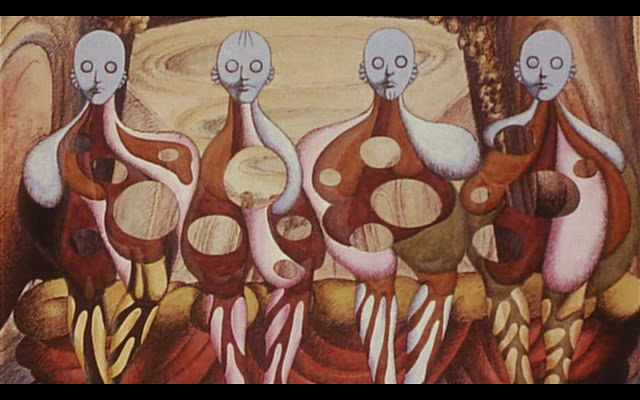
Following up the previous Moebius post with some more surreal French sci-fi, here is a (very) brief look at the 1973 Rene Laloux classic La Planete Sauvage.  It is a film that could ONLY have been made in the early 70s, and the same goes double for its trailer; I love how the super-anesthetized chick doing the voice-over sounds like she's been Quaaluded into a kind of 70s Stepford HAL:

  
Animation can be very hit and miss for me personally, but I have a real soft spot for this movie.  Its plot is a pretty intelligent and engrossing variation of the Prometheus myth, where earthlings have become the diminutive pets (when tame) and detested vermin (when wild) of a race of highly advanced blue humanoids called the Draags.  What really makes the film such a consistent and rewarding aesthetic experience, however, is its remarkable, surrealistic design sensibility.  This aspect of the movie was largely the brainchild of the intriguing French illustrator, actor, and novelist Roland Topor.  I came across Topor earlier this year when I watched Roman Polanski's deeply strange and macabre 1976 thriller The Tenant.  Topor wrote the source novel and I'd like very much to track it down; the film is fascinating, and may be Polanski's best.  Here is Topor and some of his artwork: 


With its soundtrack and general mood dating it firmly in the weird post-psychedelic headspace of the early 70s, Le Sauvage Planete takes the viewer on a trip into the pictorial antipodes of the conscious mind, where we see forms which appear alien and inexplicable, and yet feel weirdly familiar and natural.  The imaginative boundaries of much popular animation today (Pixar, for example) is extraordinarily tame in comparison, considering the capacity of animation (and contemporary technology) to take us to truly otherworldly places.  I should say, though, I'm probably the only white person of my generation who doesn't love Pixar movies.  


 The images from La Planete are from HAPPIER CIRCUMSTANCE 

The Roland Topor images are from art of the beautiful -grotesque.


Monday, March 25, 2013

Jean Giraud.


These images come from quenched consciousness, a brilliant tumblr devoted to the work of Jean Giraud (Moebius).  Well worth a visit.


Thursday, February 7, 2013

Quasi at the Quackadero and Make Me Psychic: Two Cartoons by Sally Cruikshank.


Sally Cruikshank is an American cartoonist and animator who worked on Sesame Street, and developed a very distinctive psychedelic aesthetic in her own animated shorts and painting.  I'm posting some of her artwork here, as well as two films, 1975's Quasi at the Quackadero (inducted into the National Film Registry) and 1978's Make Me Psychic.  These cartoons are wonderful; they really move in a very surreal, psychedelic style all of their own.  I'd love to see them in higher quality.


DVDs available here.

Sally Cruikshank gallery here.

Monday, August 20, 2012

Other Worlds (Jan Kounen).


Praise be to the Daily Grail for turning us on to Other Worlds, a really enjoyable documentary about shamanism and the powerful spirit vine ayahuasca, featuring contributions from a role-call of psychedelic heavyweights, including Stanislav Grof, Rick Strassman (author of DMT - The Spirit Molecule), Jeremy Narby (author of The Cosmic Serpent: DNA and the Origins of Knowledge), as well as visionary artists Pablo Amaringo (whose work is pictured above), Alex Grey, and the late, very great Moebius. Recommended:


Tuesday, August 7, 2012

Like Working without Working: The Spirit-guided Art of Augustin Lesage.


Via translinguistic other (via disinfo), I discovered the work of Augustin Lesage (1876 - 1954) today. There seems to be a dearth of English language information regarding the artist, but his French wikipedia entry informs us that Lesage was born in the north of France, and spent much of his early life working as a laborer in the coal mines near Saint Pierre les Auchet. It was while working underground that Lesage discovered his vocation: in 1911, a voice whispered to him "One day, you will be a painter."

Later, Lesage became active in local Spiritualist circles, and opened a regular channel of communication with the spirits via automatic writing. Once again, the voices from Elsewhere took a firm command of Lesage's artistic career; if he, or his French wiki is to be believed, they told him what paints and brushes to buy, and insisted that he worked on large, three metre square convases.

For the next two years, Lesage returned home from the mines and worked on these canvases, apparently guided at every turn by the spirits. Of this process, Lesage made a comment which speaks to the passive, receptive nature of creativity when it is operating at its highest pitch: "It was like working without working." The idea of spirit guidance may not be something that many contemporary readers are apt to take very seriously, but it is as good a metaphor as any to describe the essentially mysterious engagement with the unconscious (whatever that is) which often must be incurred in order to produce great art and science.

The disinfo post comments "They share a visual resonance with the often reported DMT visions of fantastic and unbelievably ornate architecture, dense vistas of cryptically purposeful temples-within-temples made of transparent jewels. I've seen these "places" on a few occasions, and it does make me wonder what was happening neurochemically in the brains of visionary artists such as Lesage, William Blake, Grant Wallace, or James Hampton and his posthumously discovered Throne of the New Millennium." Here are some pieces by Lesage; check out more at tranlinguistic other where the images can be clicked to view in greater detail:


Sunday, April 29, 2012

Summer Round by Belbury Poly (2012) and Genesis by Ron Hays (1981)

Some beautiful sounds and visuals in this excerpt from Ghost Box Music founder Julian House's film New Summer Wavelengths, featuring the haunted library/prog of the Belbury Poly:


Here's an example of a slightly similar audio-visual piece from way back in 1981: Genesis, featuring animation by Ron Hays and an excellent synth score by Ragnor Grippe:


Found at Boing Boing and the M.O.P. Radionic Workshop, via feuilleton.

Wednesday, April 25, 2012

"Well, Dr Leary, I find your product boring."


"He's not making this up. It's from the Tibetan Book of the Damned."


Meanwhile, at roughly the same time, in a mansion at Millbrook, New York, in the more or less real world...

"The long telephone wire of history, which goes back 2 billion years, and which is buried somewhere inside your brain and mine...."


Lurking outside the Millbrook estate hoping to bust Leary was an FBI agent called G Gordan Liddy, who would later supervise the break-in and wiretapping of the Democratic National Commitee headquarters in the Watergate Complex, and make guest acting appearances in various TV shows, including Airwolf, Perry Mason, and Miami Vice.

"It is primo, radical, bitchin' trip.."


It's a strange world

Sunday, April 8, 2012

Kosmische Musik: Timothy Leary, Brian Barritt, Ash Ra Tempel, and the Making of Seven-Up.


On September the 12th 1970, Timothy Leary escaped from San Luis Obispo minimum security prison, in one of the most colourful and scarcely believable episodes in his remarkable biography. In January of that year, he had been sentenced to twenty years in prison for two relatively minor drug charges. Given a psych test in order to assign a suitable location and occupation while incarcerated, Leary answered the questions in such a way as to suggest that he was a low-risk, docile conformist who loved forestry and gardening. Leary could manipulate the test so easily because he had played a crucial role in designing it himself some years earlier. This fact in itself is telling of the extraordinary trajectory of Leary’s life in the sixties – how he had transformed himself in a few short, helter-skelter years from a respected Harvard lecturer to a charismatic Pied Piper of the counter-culture whom Richard Nixon called “the most dangerous man in America.”
It was via that skilful manipulation of his psychological profile that Leary found himself in the gardens of the California Men’s Colony West at San Luis Obispo. On the night of the 12th, the then fifty year old former Harvard lecturer climbed a tree in the exercise yard, jumped from there to the roof of the cellblock, and from the roof clambered across a telephone wire to freedom, while an unwitting patrol car passed underneath. A few days later, Leary (disguised under a bald wig) and his wife Rosemary Woodruff were flying to Algiers with false passports. Their escape out of the country had been masterminded by the Weather Underground, and funded by a group of LSD distributers and connoisseurs from Orange County who called themselves the Brotherhood of Eternal Love. You couldn’t make it up.
In Algiers, Leary sought the patronage of another revolutionary and fugitive from the US penal system. The writer, activist, and Black Panther leader Eldridge Cleaver had fled a charge of attempted murder to Cuba, and from there established a small Black Panther “government in exile” in Algiers. However, Tim and Rosemary’s time with the Panthers was tempestuous; Cleaver regarded Leary’s espousal of drug use as inimical to the revolutionary struggle, and eventually placed the Leary’s under “revolutionary arrest”. This ideological disagreement between Leary and Cleaver is captured in this fascinating short piece of film from that period:
From Algiers, the Leary’s next port of call was Switzerland, the birthplace of LSD. Here they were initially supported, and eventually incarcerated once again, by an extravagant arms dealer called Michel Hauchard. Hauchard rather nobly claimed that it was his “obligation as a gentleman to protect philosophers”, but it is suspected that his real motivation lay in the possibility of a lucrative film deal. Eventually, however, Leary did find a certain brief oasis of stability in Switzerland; a stability relative, of course, to the general hedonistic chaos that he had eagerly courted since turning his back on the Establishment in the sixties. Rosemary, perhaps unsurprisingly, divorced him, but he had sold a book, Confessions of a Hope Fiend, to Bantam and brought a yellow Porsche with the proceeds. According to a 1972 Oz interview, Leary found himself initiated into the upper echelons of decadent and enlightened Swiss society: “In Europe we have been contacted by several elitist, aristocratic, thoughtfully decadent drug taking groups of older people, who follow traditions which trace back through French poets, German mystics, elegant hashishines, silk-satin opium adepts. It’s a deep, wise old continent, and quite together at the moment.” Leary was also contacted at this time by a representative of a burgeoning and culturally prescient musical scene that had emerged in Europe: the Kosmische (Cosmic) Musik scene in Germany.
While popular British and American rock music of the seventies was laying the foundations for heavy metal and the eventual self-parodic heat-death of 80s poodle rock, something altogether more futuristic and strange was happening in Germany. Beyond their respective cult followings at home, and a small but feverish underground audience in Britain, the significance of the various bands that would come to be labelled “krautrock” was little understood or appreciated at the time. In the twenty first century, 70s German experimental rock would be lionised and even fetishized to an extreme degree by musical connoisseurs with an increasingly vast and atomised store to draw from. As such, it was apt that Leary, who always seemed peculiarly ahead of the curve, should have wandered briefly into the orbit of this musical future in the making, more or less by accident. Ash Ra Tempel were working on their third record in 1972, and wanted very much to collaborate with Alan Ginsberg; however Ginsberg was nowhere to be found. When they discovered that Timothy Leary was in Europe, they decided that he would make a perfect Ginsberg-substitute. Leary, meanwhile, suffering from writer’s block, had enlisted the creative assistance of counter-culture writer and psychedelic adventurer Brian Barritt:
Leary and Barritt were a marriage made in some kind of heaven. Prior to working with Ash Ra Tempel, they had channelled the spectres of Alesister Crowley’s notorious Enochian encounter in the Algerian desert, dabbled in heroin, allegedly established an occasional telepathic rapport, and developed a complex theoretical taxonomy of human consciousness which came to be known as the eight circuit model of consciousness. The eight circuit model is a little too involved to get into here, but it should suffice to say that the eight circuits are latent or potential mental states or modalities contained in human consciousness. The initial four, or larval circuits, are concerned with basic survival instincts and desires for egotistical satisfaction; the larval circuits are rooted in terrestrial evolution. The concluding four, or stellar circuits, are concerned with mystical, higher, integrative states of awareness and psychedelic experience; they are perhaps evolved specifically for future generations that will successfully migrate off-world to explore cosmic space. Barritt and Leary suggested to Ash Ra Tempel that they make the proposed album a kind of aural modelling of the ascent upwards through the eight circuit model of consciousness. The result was Seven Up, a record named after a bottle of the innocuous beverage that Leary’s son in law had passed around to the band, without informing them that it was spiked with potent crystal acid. The making of the record looks like it was the kind of gas that most mere mortals could barely withstand:
You can listen to the whole record below. The opening sections, composed of ragged blues work-outs fading in and out of spacy washes of synth, don’t immediately inspire confidence, but it’s worth toughing it out. The concluding ten minutes are a gorgeous catapult into the higher reaches of the lysergic empyrean. Shortly before his death, Leary commented to Brian Barritt regarding their involvement in kosmiche music, “Well, Brian, we landed in the right place at the right time….”, a sentiment that could easily have served as an epitaph for the whole of his incorrigible adventure in the culture of the twentieth century.

http://www.higgs1.demon.co.uk/barritt/mojo.htm