Sunday, May 31, 2015

The Bird Out of Space and Time (Part 6).


8.

Though my delusion of being the only inhabitant of the high rises was not destined to last too long, that drear, interminable February saw the onset of my newfound agoraphobia.  The Harrington/Sheldrake was located on the quays of a river that runs straight the length of the city.  The Quarter was some distance away from the heart of the city, a short walk from the humming industry and slanting cranes of the port at the river’s mouth. 

There was two directions in which I might walk: along the river to the east, towards the port, or back, westward, into the city.  Either side, there was really nothing, only mazes of old housing estates, desolate warehouses, and junk-yards.  I tried walking through these old estates at first, but their sense of seclusion and insularity oppressed me.  They were places where the people and the streets were of one character, hewn together over long generations, forged into a language and intimacy which was theirs alone.  Hearing snatches of conversation, eyeing people at bus stops and lounging outside bars to smoke cigarettes, I felt the weight of separation, of the totality of time and experience which remains unconnected to our own, and which we intersect with only briefly, at the impersonal whim peculiar to city streets.

I felt more comfortable in the Quarter, in its spartan, clean architecture, which suggested something freshly assembled.  It was a place without a past - an open community with no connections to the world around it, or even between its own separate units.

So I kept moving eastward along the quays to the mouth of the river, and the expanse of the ocean.  It was a short walk to such an illimitable cul-de-sac.  The ocean, flattened and foreshortened by my perspective, seemed to combine with the sky to form a vertical plane or wall – the flat edge where the world ceased.  This, at rate, was the feeling it evoked in me: that whatever creative agency generates the various appearances of the world became exhausted, and ceased its activities at precisely this point.  The ocean was its final act, an undulant, slumbering dream of creation where all colour and form lost their fixity, becoming liquid and protean, motionless as a whole, yet everywhere astir with the tiny scintillations of some dimming purpose, before ceasing altogether in the whiteness of the sky. 

This sense of a precipice or impassable barrier was accentuated by the diagonal arms of the cranes, which resembled the skeletal frames of an uprooted bridge, and the funereal slowness of the large container carriers that moved across the port like leaden clouds.  Throughout the month, thick fog banks drifted in from the ocean, as though the world’s exhaustion, the final diminution of its creative powers, was spreading slowly back inland, softening and stealing away the solidity and texture of things, drawing everything towards the glazed pallor of the sky.

So I walked westward along the river, towards the city centre.  This was a longish walk, which could take up to an hour at a decent clip.  The quays were a disorientating mixture of very old and very recent architectural developments.  The newer additions, like the Harington/Sheldrake, were modernist gentrification projects infused with a vague air of science fiction utopianism.  They had revoked the idea of being mere buildings, aspiring instead to a sense of rooms floating disembodied in sheets of glass, rectilinear hives wrapped around supple new curvatures, like soap bubbles straining to take flight.  They emphasized pristine whiteness, soft, fluorescent neon hues, and the absence of colour in the milky reflection of polished glass.  All in all, they embodied that ubiquitous aesthetic whose centre of gravity is the unadorned screen.
 
All borders around the screen were vanishing - the building had become a window, and the television itself, almost imperceptibly, had ceased to be a television, becoming instead merely its screen.  These new structures reflected a post-industrial ethos, a world in which ideally nothing was built, and hence the architecture sought to make the actual trappings of building and construction invisible, and the finished structures as sleek and diaphanous as possible.  They were, I suppose, intended to be like information in the current regime: content without a physical container; soul, or some intimation of the presence of a soul, without a physical body to situate it within the levelling flow of time.

These new developments appeared incongruous, almost like mirages or will-o-the-wisps, in the context in which they had been marooned: old streets whose concrete and stone showed their ruggedness and age, the muscle and sinew of dormant industries and freight routes, abandoned warehouses and tracts of weed-mottled wasteland, housing estates built in the 70s in the style of unpoliced prison-yards, occasional town houses of the 18th and 19th centuries, further marooned, whose interiors might have housed insular and highly evolved breakaway civilisations of squatters, artists, scavengers, and revenants.  Marinas crested the gentrified districts, like pictures from second-hand books that memorialized fading aspirational horizons, old dreams grown keener and more distant in an aging and neutral landscape of middle years.  As I walked, I always felt a peculiar sensation, as though my own past were falling after me like a trail of breadcrumbs, but the breadcrumbs would not lead anywhere, because they were cast up in a breeze and scattered, or picked away with mechanical briskness by seagulls.  It felt as though my mind were being wiped clean, and my identity nullified somehow, so that my impressions had a cold, pristine quality, like the world perceived by a somnambulist: a mysterious, discontinuous landscape, haunted everywhere by dim intimation of the slumbering awareness which would make sense of it all. 


Memories came to me then, but of a peculiarly detached quality, as though they belonged to somebody else.  In the most persistent of these fugitive memories, I am a child, staying in some great old town house in a leafy estate by a canal.  I am exploring a cabinet in the alcove of a dimly lit hall.  An old woman, whom I am desperately afraid of, is asleep in a nearby room.  The cabinet contains a book of strange heraldic symbols and allegorical emblems.  I always pause at one particular image.  Two children, a boy and girl, are setting off on an open country road, their possessions bundled in sticks over their backs.  To their right, an amiable looking peacock stands at the gate of a meadow, apparently talking to the children.  There is a sly, languorous serpent curled up at the feet of the peacock.  In the sky above the winding road, a cobbler hammers at a pair of shoes, his head downcast and absorbed in his work.  Beneath the image, the following is written:
The Peacock of Plenty: REJOICE, GOD HAS FASHIONED FOR THEE A STRONG SOUL, TO WEATHER THE LONG, UNCERTAIN ROAD.
THE SERPENT: AYE, BUT WHO FASHIONED THE LONG, UNCERTAIN ROAD?


By this point, I would usually be arriving at the financial district, and the beginnings of the city proper.  But I could never go any further.  I was tempted to revisit some of my old haunts, but the prospect always intimidated me.  I’d been living a strange, solitary kind of existence for some time at that point, and was troubled by the possibility that I might have changed in some fashion, unbeknownst to myself.  Perhaps, by increments of degradation too gradual and subtle to register, I had become some kind of dishevelled, wild-eyed Crusoe.  Or, worse still, perhaps my outward appearance remained unchanged, but my mind had gone so far outside of the pale of routine existence as to be exposed as sheer bedlam when reacquainted with ordinary society.  It was possible that I’d replaced the shared world of everyday reality with a private world of concepts and phenomena entirely of my own invention, again in a process slow and cumulative enough to have evaded my awareness.   If I met an old acquaintance out and about, I might endeavour to keep the conversation in the safest, most banal territory – the weather, for example. 

What if, however, there was in actuality no weather?  What if the atmospheric conditions and temperature of the earth remain always in a perfectly static equilibrium state, and “the weather” was merely a delusionary system of my own invention, an elaborate persecution fantasy of some sort?  Worse still, perhaps it was an entirely commonplace delusion, a well-known foible of the most unimaginative lunatic: sufferers of this type of delusion, writes Konneigan, are subject to the belief that the entire earth is prone to fluctuations in temperature and atmospheric condition, almost like mood-swings or tantrums.  The entire lifestyle of the patient is structured around ritualistic attempts to placate and curry favour with this belligerent atmospheric daimon, most notably through the periodic alteration of diet and attire.  During periods of the “weather’s” sterner, more vengeful incarnation, the patients dress in attitudes of extreme modesty, huddled and covered-up like penitents or nuns.  Walking around, they are often seen scowling, grimacing, and shivering, as though embroiled in an internal struggle with their “weather.”  In contrast, during its lighter, more benevolent incarnation, the patient becomes a virtual libertine, shedding the excess clothing, and frequently presenting themselves in attitudes of carefree, sensual submission to the “weather.”   

Clearly, the “weather” serves a very complex series of functions in the mental ecology of this type of patient.  It places them in an intimate relationship with the world, solar system, and cosmos as a whole.  In their delusionary system, the indifferent atmosphere cares enough to subject them to personal punishments, or lavish warmth and a sense of well-being upon them.  As such, the “weather” allows them to project an intertwined parental, religious, and erotic psychodrama onto the canvass of an indifferent world.  The delusion is so thoroughly engrained in their mental ecology that it is normally the first thing they discuss with strangers, as though it were the most universal, quotidian subject imaginable. 
         
 These thoughts, which I found on the whole rather gloomy and paranoid, tended to stop me in my tracks.  Then I would consider the city itself, reconstructing it like a vast memory palace whose various streets and structures concretized my own moods and desires, the fitful, meandering course of my destiny.  The city had been like a deck, shuffled and re-shuffled, bearing emblems of desire and failure, presages of abundance and disaster, certain longed-for cards that remained invisible, almost forgotten, ever sought after; streets of chance that I went down endlessly, seeking after somebody whom I believed I’d once vowed to find again, somebody who also sought after me, so that we traced blind orbits around one-another, serene and hopeless, unable to relinquish the quest or ever reach its final object.  That seemed all finished to me now; whatever I had been looking for, I would not find it.  I would not thread the streets of chance again, until something had become fixed in myself.  This, or so I imagined, was what I was doing in the Quarter.  I had been called there, to remain absolutely stationary and detached from life, to become an observer of a process which was underway either in my own mind, or the world, or in both. 

Formulating these conclusions, I found that I had been gazing idly across the river at a tiny antique store sandwiched between two imposing derelict townhouses.  The place was called Kazanian’s.  The letters formed a yellowing arch on a window rimmed with a coating of brownish grime that lent it, as though by design, the texture of an old photograph.  Beneath the lettering, a lovingly arranged tableau of bric-a-brac: an art deco clock in the centre, surrounded by wax flowers, porcelain dolls, snuff boxes and miniatures in precise disarray.  Something about the shop caught my fancy, and even moved me to a certain indefinable sympathy.  Located as it was in the midst of such dereliction and emptiness, it gave the impression of a hopeless persistence, as though the whole world had come to a stop around it, and it had simply carried on, opening its doors dutifully each morning, hopeful each day of fresh custom in a silent, ravaged city.  I imagined its proprietor as the last man on earth – a harmless, hapless individual who rose every morning in squat lodgings to the rear of the shop, talking eagerly to an adopted wild cat that munched scraps and eyed him suspiciously, every day without complaint, every day with the impossible hope of the doorbell chiming.  The antique shop was itself the ultimate antique, the last vestige of a vanished civilisation, persisting by a blind, spectral habit as the world’s decay ripened around it like a fecund garden.  Moved more by this imaginary scenario than any actual circumstance of the building itself, I hastened across a bridge, and went within.

The arrangement of the shop was typical of such places, in that it was constituted entirely of its wares.  Other shops had their own shelving, displays, and so forth, but the antique shop such as Kazanian’s could be entirely functional: its smaller items were displayed on tables to the centre, and cupboards and cabinets along the walls, which were themselves for sale.  Kazanian’s went further than most in this regard, in that even its antique cash register had a price tag.  A wealthy individual could, if such were his whim, walk in and empty the premises at a stroke.  It wouldn’t have surprized me too much if the proprietors’ own garments were also for sale, and I imagined the scene, after some playful profligate had brought out the entire business, either as an act of kindness or some prank: the proprietor seated in his long johns in the bare room, his face rapt with the peculiar humiliation of arbitrary triumph.

Of this proprietor, I should say a few words.  He was seated, if seated is the right word, in a rocking chair against the far wall, between a grandfather clock and large globe whose continents were barely legible beneath a thick mildew.  He was one of those extremely tall, slender old men whose white, unwrinkled faces have reverted to a childlike air of buoyancy and simplicity.  He beamed at me when I entered the shop, but said nothing, rocking back and forth on the chair with a boisterousness which was unseemly and disconcerting.  I took an immediate disliking to this seller of antiques.  It seemed to me that to use one’s wares in this fashion was hardly conducive to sale – it could only be the most doltish of bed-salesman, for example, who would copulate vigorously with his wife or mistress upon the emporium’s centrepiece, without expecting some adverse effect on the customer’s ability to browse or desire to purchase, however the display made ample demonstration of the product’s durability.  That elderly gentleman’s rocking had a similar effect: even when I turned away from his serene, almost simpering expression, the metronomic creak of the chair engendered an atmosphere of heightened tension.  I would have left the shop immediately, but my eye was caught by a book in one the cabinets: an original Shadwell’s imprint of The Path Out of Malkuth by W.E. Pusey.  Though I had never read it, the collection of short stories and essays was instantly recognisable to me from my erstwhile Pendleton studies.  The two men had been friends, after a fashion, prior to Pusey’s disappearance.  Although I had long since repudiated those studies, the book exorcised a certain fascination, and I knew that the Shadwell originals were as rare as rubies.  I took the book from the cabinet, opened it at random and began to read:

“At evening-rise, Kadmon stole nimbly into a large square.  The atmosphere of the square was melancholy and eerie.  At its centre was a dry, sand-clogged fountain, and all about it remained the tables and chairs of long abandoned restaurant terraces.  Rising up to an immense height at each side of the square were stone apartment towers, with all their windows and balconies in darkness, so that the entire square was shrouded in an immense gloom.  In the older times, it would have been a scene of considerable gaiety and boisterousness, with musicians playing by the fountain, youths dancing, and the migrants seated at the terraces, eating and drinking as was their want.  The great faces of the stone towers would have danced with the fires of candles and lamps, and lithe, indistinct figures lounged on the balconies that reached up into the evening colours of the firmament.”

“Now the walls of the towers were densely twinned with the thick, flowerless limbs of that strange plant that grows out of the desert floor, and wraps its limbs around untended places as though to strangle them, or pull them back beneath the sand.  A group of five elders sat by a fire at one of the terraces; their eyes were fixed either on the fire or the old fountain, and they barely spoke.  Kadmon resolved to move swiftly away from this dreary scene, but his eyes lighted on something peculiar as he passed through the square.  In a window about half way up the eastern tower, the reddish glow of a single lantern was visible.  This was a strange thing, for it was the city ordinance that while a tower was abandoned, every floor above the third must be rendered inaccessible by a stone barricade, so as to prevent infestation by undesirables and criminals.  Kadmon observed two shadows in the gleam of the lantern: one appeared to be an emaciated man seated on a couch, and the other a child that capered and danced around the room.  Those shadows, vague and phantasmal as they were, caused a little chime to echo through the halls of Kadmon’s memory, for thieves never wholly forget a tale they have heard of some treasure worth stealing,or weird adventure worth risking.”

“He sauntered over to where the elders were seated to inquire into the mystery of the single occupied apartment, and was greeted with typical coldness and suspicion.  ‘Good evening-rise, friends,’ he began, ‘and please excuse my interruption of your leisure in this palatial square, but I must own that my curiosity, much exercised and keen through a lifetime of honest travel through our great city, has been considerably sparked by the mystery of that light that burns in yonder tower.  What kind of man or fiend, I wonder, would live so high up in an empty tower, and how does such a creature even accrue to himself the means of subsistence, marooned up there at such a height?’” 

“There was a long pause in which the elders fixed their eyes everyway but in Kadmon’s direction.  Finally, the woman who sat nearest him spat vehemently on the ground, and began to speak:  ‘The apartment has been occupied by a hateful old wizard since I was a child, and in those very old times, he was often seen going about the district.  He carried himself with great haughtiness, as wizards do, and insulted and abused people as was his wont.  But then there came into his possession a certain magical hourglass, and turning that hourglass and gazing into the falling of its vermillion sand became all his pleasure, and no more did he leave his apartment high up in the eastern tower.  The years past, ill-fortune came to our district, and gradually the towers became derelict, but that wizard, ever absorbed in the visions vouchsafed him by the hourglass, paid no heed to the world’s comings and goings.  He has a little trained monkey, a creature of abysmal cunning and malice like its master, and each day that monkey climbs down from the tower and steals what little food the wizard requires to sustain his worthless and sedentary existence.  He is a pest, stranger, and there is no doubt that his nightly turning of that unholy hourglass has brought no luck to this district.’” 

“The stirring of Kadmon’s memory had been correct: he had heard in the past of a decrepit wizard who possessed a powerful talisman of the lizard people which was called the Hourglass of Aeons.  ‘Friends, I am the thief called Kadmon.  If you have heard the tale of how the Elephant God’s Nimbus was clutched from the yellow-robed priests of Yanni, then you know of my renown.  Tonight I will pay a visit to your wizard, and perhaps earn some readdress for the prolonged nuisance he has brought to your district.”  There was another pause, until again the woman spoke: ‘The tale of the Elephant God’s Nimbus is a good one, stranger, but is it true?’ 
“Kadmon, however, was already striding in the direction of the eastern tower.”

Absorbed in my reading, I’d failed to notice that the chair had ceased to rock; finally I registered with a start that the proprietor was standing over me, his stature almost prodigious.

“Are you interested in buying that one, sir?” he asked in a mellifluous yet distant voice.  “I only ask because you seemed quite absorbed in its contents, sir, like one happily drowning in ambrosia.”


A rather ominous display of bric-a-brac, Nantucket, 1880.

Continued shortly.

Wednesday, February 25, 2015

Professionalism No Longer in Control: Michael Mann’s Blackhat.


Contains spoilers.

In a key scene in 2009’s Public Enemies, John Dillinger is ushered into a backroom mob exchange where racing scores are relayed to bookies before they are announced.  “Look around you”, Phil D’Andrea (John Oritz) says to the storied outlaw, “what do you see?”

Dillinger:  “A bunch of telephones.”

What Dillinger can’t see is a newly emergent order, dovetailing in the worlds of both crime and crime prevention.  Mann positions this exchange as a quietly chilling vision of the shape of things to come; as D’Andrea explains:  “On October 23rd, you robbed a bank in Greencastle, Indiana. You got away with $74, 802.  You thought it was a big score?  These phones make that every day.  And it keeps getting made – day after day, a river of money, and it gets deeper and wider, week in and week out, month in and month out, flowing right to us.”  What is being contrasted here is traditional physical labour (represented by Dillinger and the outlaws) and a new form of enterprise which doesn’t involve work per se, but rather accrues vast profits by virtue of manipulating communication (or information) technology.  Traditional labour and capital is replaced by the flow of money and information facilitated by a communication network. 

Six years later, Mann’s latest Blackhat is an exploration of the forms that new order has taken in the 21st century, some eight decades after the events depicted in Public Enemies.  In Enemies, telephone lines were turning crime syndicates into national corporations, and the F.B.I. beginning to erode individual privacy via wire-tapping.  Blackhat is a crime procedural set against a contemporary backdrop in which the globalized interconnectedness of computers has made the flow of money and information byzantine and perilously unstable, and an omnipresence of surveillance and digital technologies means that every place, every moment, is potentially being recorded, scrutinized, and transformed into further pockets of data in an over-congested system.  As such, it continues Miami Vice (2006)’s preoccupation with the flux and velocity of globalized late-capitalism, with the sense that its freedoms of movement come at the cost of entanglement in wider, overarching systems where the product moves and the personnel are interchangeable and expendable. 


Blackhat also continues Mann’s drive to evolve a distinct cinematic language which is congruent with the digital present rather than the filmic past.  This bold endeavour, ongoing since the director’s first tentative experiment with digital cameras in 2001’s Ali, has lead Mann to produce movies which are increasingly paradoxical hybrids of Hollywood blockbuster and abstract experimental film.  This has made Mann’s entire late career something of a sustained film maudit, with each new film generating sharper critical division, more ardent championing from a cineaste minority, and increasing disinterest from mass audiences.  As such, it’s hard to write about Blackhat without engaging with its disastrous commercial and critical fortunes, and the ongoing controversy surrounding Mann’s late career embrace of digital aesthetics and minimalist story-telling/characterisation.  One thing seems clear enough, however you rate the film’s successes or faults, the most common charges levelled against it by critics were patently wrong-headed.


Blackhat was charged repeatedly with being generic, clichéd, and preposterous in its plotting, and lumbered with a miscast lead.  On paper, its plot certainly appears to justify the suggestion.  The furloughing of one master crook to catch another, more nefarious crook is a common enough device in b-movies, and the ultimate scheme of Yorick van Wageningen’s blackhat Sadak  – to flood several Malaysian tin mines in order to make a killing with tin futures – has the air of a Bond villain’s shenanigan.  It’s worth noting, however, that the scheme never actually comes to fruition.  A genuinely clichéd or generic film would have built to the flooding of the river-bed as its climatic set-piece, to be averted at the last minute by the hero.  But this plot, ultimately, has very little significance in Blackhat – once established, it fades into the background.  Even Sadak himself doesn’t seem unduly committed to it – he suggests that another, comparable scheme could be set up in a matter of months.  This underlying scheme is largely a maguffin, and the film is far more interested in the processes by which the hacker operates, and the trail – both in the digital realm and the macro-world – by which his pursuers work from tangible effects in the real world, through the code, its various re-routings across the globe, back to its source.  This mixture of micro- and macro world detection unites the cinema of Mann’s past with the technological ambience of the present century – it brings to mind Manhunter’s detailed procedural verisimilitude, and Diane Verona’s speech to Pacino in Heat (“You sift through the detritus.  You read the terrain.  You search for signs of passing, for the scent of your prey, and then you hunt them down”), in a new context of digital footprints and traces.


Which is to say that there is difference – all the difference in the world – between adopting clichés and subverting them, and Blackhat subverts most of the clichés of its familiar b-movie skeleton.  In how many films of this type, for example, are the majority of the leads abruptly and coldly dispatched at the midpoint?  In how many does the initiative of the heroes effectively fall apart and end in disaster?  The majority of the team wind up dead, Hathaway fails to commute his sentence, and, as an exercise in US/Chinese co-operation, the initiative only engenders fresh suspicion and distrust.  Although the blackhat villain is successfully dispatched in the end, it is merely an act of personal revenge undertaken in a brutal street fight; as in the conclusion of Miami Vice, there is little sense of catharsis or lasting achievement, only eyes traded for eyes in the murk of an on-going war.   To call the movie clichéd and preposterous does little justice to the way in which Blackhat repurposes its familiar generic structure into a cold, noirish procedural whose precise research and dry, low-ley approach lend the majority of the action an air of believability and authority.  Rather than being silly, one suspects that the film’s style – its slow, methodical pacing, lack of conventional connective tissue and characterisation, fascination with process and detail, and the frequent abstraction of its editing and cinematography – are a source of frustration and alienation to many viewers and critics.

Personally, I’m an unabashed fan of digital-era Mann.  He seems to me to be the most restlessly (and recklessly) innovative modern US filmmaker - an odd fact, considering that he is now in his seventies.  Mann’s recent work has the excited air of a director who is not so much trying to perfect his craft as discover it - with each film he has utilized familiar, generic material as a launching pad to explore new ways to view and experience the world through the digital camera.  Nobody shots modern technology and modern architectural spaces like him – nobody else even seems to see them in comparison.  Nobody shots actors in close-up with the same degree of intimacy and immediacy – Mann uses the compact mobility and “live” texture of digital cameras to view his actors stripped of the normal barriers of aesthetic remove felt in cinema, an effect which is particularly striking when applied to Hemsworth, whom we normally see in the high fantasy realm of the Marvel universe.  In Blackhat, these two elements – the modern techno-architectural space, and the intimacy and immediacy of the physical presence – are conjoined in various thrillingly abstract visual ways, as the film functions in some respects as a visual essay on the condition of modern living in which we are perpetually conjoined with screens and communications devices, and the fortunes of our physical bodies conjoined with the movement of intangible, microscopic electrical languages that move with lightning speed through a world grown increasingly porous and fragmented.

Mann’s cinema has always been regarded as upholding a Hawksian professionalism, or a commitment to the idea of professional vocation as a form of existential identity.  This idea has never been entirely clear-cut in Mann’s films, however; in their tragic, noir-influenced world, professional vocation offers his characters a way of affirming their selves, but one which also seems to negate their deepest emotional longings.  As such, they are always fighting a losing battle with time, the supreme, mystical entity in Mann’s cinema, which is always ebbing away, representing itself as an impossible ideal, an escape from the flux of professional activity, a brief interlude contemplating the ocean, or the nape of a woman’s neck.  Nevertheless, his characters have always exerted a tenacious control over their worlds.  This idea is most forcefully expressed in Mann’s first feature, Thief.  Master thief Frank (James Cann) has created a picture collage which represents his longing for a regular domestic existence.  In order to quickly achieve this dream, he has traded his self-employed independence for a partnership with mobster Leo (Robert Prosky).  Mann uses Frank’s entanglement with Leo as an allegory for the ways in which engagement with the system of capitalism erodes individual autonomy and freedom; he gains all the trappings of middle-class existence – family, home, investments, security – but becomes in the process a kind of serf.

Realizing this, Frank regains his autonomy in a flurry of cathartic violence, blowing up his house, his businesses, his entire middle-class existence, and abandoning the aspirational goal represented by the photo collage.  Where precisely this leaves Frank is a question mark hanging over the conclusion of Thief, but the film nevertheless allows its protagonist to exert a degree of control over his world, in opposition to the system.  This idea is repeated in the images which bookend The Insider: Crowe’s Jeffery Wigand walking out on his secure and lucrative job with Brown & Williamson, and Pacino’s Lowell Bergman walking out on his with CBS.  In his more recent films, however, it is arguable that this sense of control over ones destiny is gradually ebbing away from Mann’s protagonists: a sense that their commitment to professionalism is no longer sufficient to assert self-determination and autonomy in the face of the system.  Think, for example, of Farrell’s Sonny Crockett, the most hollow and joyless of Mann protagonists, returning with a weary thread to the trenches of the unwinnable drug war in the last shot of Miami Vice.  The ebbing away of professional control becomes more pronounced in Public Enemies.  However competent a bank robber, Depp’s Dillinger is fundamentally out touch with the changing technological structure of the world through which he moves.  No matter how good he is at what he does, his way of life is palpably at the end of its rope.  He lives in a vanishing frontier America, a wide, stratified place with ample spaces to run and hide, but technology is rapidly vanquishing the frontier, connecting and narrowing its spaces, tightening like a noose around the old outlaws.

Something of this elegiac spirit, this sense of professionalism at the end its rope, carries over into Blackhat.  This new film is set against a system which is so complex, interconnected, and decentralized that nobody can exert effective control over it – not the national law enforcement agencies, and not even the nationless outlaw blackhats who operate outside, but not unconnected with, the system.  This seems to be part of the metaphorical design of Blackhat’s final set-piece, where Mann stages the battle between his blackhat antagonists against the orderly flow of a torch-bearing parade.  The marchers appear largely unaware of the battle in their midst, and the blackhats absorbed in their conflict to the point of being oblivious to the marchers (notably, Sadak is presented as a solipsist: “When I stop thinking about something…...it ceases to exist”), but the struggle causes a disruptive chaos in which orderly abstraction invariably breaks down into tangibility and vulnerable flesh.  An earlier scene moves smoothly from a row of blue-collar tools on a table to Hathaway and Lien (Tang Wei) working at their laptops, a contrast which recalls 2001’s iconic segue from bone-cudgel to spaceship.  These primitive tools become his final weapons of choice against Sadak, a blunt rejection of the former battlefield of distant keystrokes and anonymous code.  Blackhat’s protagonist Hathaway is a genius coder, but he wants out of this vocation: his aspiration is to be a modest blue-collar worker, a repairer of TV sets and garage doors.   It seems as though the Mann protagonist, in the winter of the director’s life, is finally ready for the “regular-type” life which seemed so impossible to Pacino and DeNiro in Heat, at least as an alternative to a world where professional vocation no longer facilitates control and autonomy.  Whether or not Hathaway achieves this escape remains open to question.  Unlike many prior Mann protagonists, he doesn't have to abandon the girl, but Blackhat’s fantastic last shot invokes the spectre of the Panopticon, and seems to waver between the exhilaration of escape, and the suspicion that anonymity and escape may no longer be possible.

It is difficult not to associate this idea of professionalism no longer in control, the professional code at the end of its rope, with the increasingly fraught fortunes of Mann as an auteur operating within the Hollywood system.  Blackhat may well be the last time Mann ever gets to play around with a blockbuster budget, and his fascinating tight-rope walk between the multiplex and art-house at an end.  But if these movies thematically represented a drawing-in of deterministic forces, of mortality and the gravity of overarching systems, artistically they still assert a freedom and self-determination, even if it is, in a classically Mann fashion, a self-determination that ultimately cements its own self-destruction: a director who abandoned his mantle as a master of filmic perfectionism, to embrace the aesthetic possibilities of a new technology with all the gusto of somebody only at the beginning of their career.

Thursday, February 12, 2015

Eternal Recurrence: Alfred Hitchcock’s Vertigo (1958). Conclusion.


Part 1.

“Everything has returned.  Sirius, the spider, and thy thoughts at this moment, and this last thought of thine that all things will return.”

Friedrich Nietzsche.

“Must yet meet, attract, repulse, kiss, and corrupt each other again….”

The chief mythic idea I’d like to look at in relation to Vertigo is Friedrich Nietzsche’s concept of the eternal return of the same, or eternal recurrence.  Here, we can only use the term mythic loosely, because ideas relating to eternal recurrence take various forms.  Notions of eternal return of a kind predominate in many ancient mythical world-views, as these worldviews were predicated on cyclical rather than linear notions of time.  Variations of the idea emerge in the mythio-philosophical speculations of the Greeks, most notably in Heraclitus, Empedocles, and the Pythagoreans.  By Nietzsche’s period, cyclical time had largely been replaced in the Western imagination by the linear, narrative time of Christianity, although eternal return was occasionally mooted as a physical cosmological theory, working under the assumption that finite matter in infinite time would inevitably repeat the same configurations ad infinitum.  (This idea is expressed, for example, by the poet and essayist Heinrich Heine: “For time is infinite, but the beings in time, the concrete bodies are finite…..Now, however long a time may pass, according to the eternal laws governing the combinations of this eternal play of repetition, all configurations that have previously existed on this earth must yet meet, attract, repulse, kiss, and corrupt each other again…..”)

What Nietzsche did with this idea, normally expressed in an abstract or general fashion, was to make it immediate, particular, and starkly personal.  The notion seems to have first forcibly struck the philosopher while he was hiking in the woods by Lake Silvaplana in 1881, and would thereafter occupy a persistent albeit peculiar significance in his work.  Its most famous expression is as a kind of thought experiment in The Gay Science:
“What, if some day or night a demon were to steal after you into your loneliest loneliness and say to you: “This life as you now live it and have lived it, you will have to live once more and innumerable times more; and there will be nothing new in it, but every pain and every joy, and every thought and sigh and everything unutterably small and great in your life will have to return to you, all in the same succession and sequence?  - even this tiny spider and this moonlight between the trees, and even this moment, and I myself.  The eternal hourglass of existence is turned upside again and again, and you with it, a speck of dust.”
Nietzsche and his demon were clearly laying on the reader what was known in quainter times as a mindfuck, possibly even a bummer.  The idea of eternal recurrence, stated thus, places a great existential weight on every detail of our lives, on each of our actions, from the tiniest to the most significant.  Normally, we whittle a great deal of time away on the basis that we will perform the significant, defining actions of our life in due course; we are, as the school of Gurdjieff assert, habitually asleep, hypnotised by the notion that our real lives are eternally deferred.  Nietzsche’s conceit can thus be seen as an attempt to shake the reader out of their lethargic trance, and force them to contemplate the value or worthiness of their existence in its past and most immediate dimensions.   In Nietzsche’s time, the value and worthiness of a life was largely regarded as a matter to be judged in the eternity of the afterlife.  The idea of post-mortem judgment was of course an anathema to the fiercely atheistic Nietzsche, who thought metaphysical consolations of this type represented an abject devaluation of life in this world: “To talk about ‘another’ world than this is quite pointless, provided the instinct for slandering, disparaging, and accusing life is not strong within us: in the latter case we revenge ourselves on life by means of the phantasmagoria of ‘another’, a ‘better’ life.”  (Twilight of the Idols).

Eternal recurrence can then be seen as a conceit by which Nietzsche turned the “phantasmagoria” of post-modern judgement back on itself: a secular eternity whose heavens or hells are made each day and each minute of our lives, because they alone constitute our existence, now and in eternity.  This, at any rate, is how the idea is most commonly understood, but there has never really been a consensus: to some, eternal recurrence is to be taken as a literal doctrine, to others, a sign of Nietzsche’s incipient madness.  Whatever the case, the idea held a particular glamour over his mind, moving him to a type of poetry occasionally reminiscent of Lord Dunsany and some of the Weird writers: 
“Your whole life, like a sandglass, will always be reversed and will ever run out again – a long minute of time will elapse until all those conditions out of which you were evolved return in the wheel of the cosmic process.  And then you will find every pain and every pleasure, every friend and every enemy, every hope and every error, every blade of grass and every ray of sunshine once more, and the whole fabric of things which make up your life.  And in every one of these cycles of human life there will be one hour where, for the first time one, and then many, will perceive the mighty thought of the eternal recurrence of all things:- and for mankind this is always the hour of Noon.”
How somebody might respond to the prospect of eternal recurrence would depend to a large extent on how they regarded their own lives, or at what point the demon accosted them; the eternal repetition of a satisfactory life, or an ecstatic moment, is an appealing prospect, just as that of its opposite is not.  Nevertheless, although Nietzsche seems to have intended the notion to give a resounding affirmation to life, it carries something of the ambience of a depressive’s persecution fantasy.  Eternal return in a general sense – the seasons, the diurnal and cosmic rhythms of the planet – can be an aesthetically pleasing and comforting notion, but in relation to the life of an individual, the idea of an implacably fixed repetition of the same is more apt to engender a sense of despair and impotence.  One thinks of the eternal punishments of Tantalus and Sisyphus in the Underworld: the waters always receding beyond our grasp, the boulder tumbling back down to ground, the endless reiteration of futility, and the endless inability to forsake the futile activity; or of St Augustine’s assertion that the path of the sinful man is circular, and Dante’s realization of this idea in the topography of the Inferno; or the repetitious existence of the addict, and the endless circuitous return of the mind enthralled by obsession or guilty conscious.


Interestingly, the idea of eternal return did haunt the modern imagination, but much less in the affirmative sense, “the hour of Noon”, implied by Nietzsche, and much more with the ambience of the hopeless, the absurd, and the inescapable.  The return of circular time seemed to haunt the modernist imagination as a kind of subterranean rebuke to the redemptive linear time of Christianity, and its secular derivative in the hope of social improvement and technological progress.  A horror of repetition, a sense of the impossibility of real change or progress, seemed to underline the fixed laws of nature, the unyielding routines of the factory and assembly line, and the depersonalized circumlocutions of the bureaucratic world.  We find this shadow of eternal Sisyphian return directly invoked by Camus, and colouring the plight of Beckett’s tramps and Kafka’s hapless victims, or implied in Borges’ preoccupation with the maze and the labyrinth, the forked path which brings us ever back to our initial point of departure.  In the cinema, we find the purest expression of these ideas – the maze, the labyrinth, eternal return – in Alan Resnais’ modernist classic Last Year at Marienbad (1961), with its purgatorial hotel of arbitrary, unwinnable games and protagonists who are meeting each other for the first time, or perhaps only the latest in an interminable sequence.


From Among the Dead, or There’ll Never be Another You.

Although probably not intended as such by Hitchcock (or the authors of D’entre les morts), eternal return is an intriguing prism through which to view Vertigo.  The film is after all the story of a man who is persecuted by return: the acquisition and loss of his beloved, repeated as a pattern, always returning him to his initial emotional state of impotence and guilt, to an emotional state of abjection which intensifies with each reiteration.  The idea of inescapable return – of the past, of the obsessed mind to certain events, ideas, and fetishes, of the ghost to certain emotionally resonant locations, of the world of the living to the world of the dead – is intricately woven into the whole fabric of Vertigo.  The idea is concretized by the film’s presiding visual motif: the spiral, which we see repeated in the credits and Scottie’s nightmare, Madeleine’s hair, the staircase of the bell-tower, and the film’s famous 360 degree camera pan around Stewart and Novak’s kiss:


As an interesting aside, the most prominent recent appearance of eternal return in popular culture was of course among True Detective’s seething cauldron of decorative philosophical intrigue.  This show also adopted the spiral as its presiding visual motif:


The spiral, and the return of the past, also informs Vertigo’s remarkable utilization of its San Francisco location.  The city in general makes an ideal physical embodiment of the idea of a temporal maze, of the past haunting the present.  Despite their relative antiquity, cities retain always the sense of being the locus of the modern, the new, the present instant.  Cities register changes more rapidly, in human time scales, as against the slower rhythms of change in the natural world.  But cities are also a physical record of their own histories.  They are in a sense their own museums, with the modern facades the glass enclosures through which their prior forms of existence are made visible.  Vertigo’s San Francisco is a city defined both by its own history, and the interpenetration of its communal history with the personal histories of its protagonists.  Its locations are all steeped in local history: old churches, graveyards, museums, and antiquarian bookstores.  Through Scottie and Judy/Madeleine, these old stories are being reincarnated, the locations becoming enmeshed in new emotional complexes and tragedies.   In this intervening of personal and communal history, Vertigo’s San Francisco is never a wholly objective, spatial terrain; it is marked out, arranged according the subjective emotional histories and obsessions of its characters.  Guy Debord defined the now highly fashionable concept of psychogeography in 1955 as “the study of the precise laws and specific effects of the geographical environment, consciously organised or not, on the emotions and behaviours of individuals.”  Applied to urban areas, psychogeography offers maps for exploring how the fixed spatial organisation of the city becomes randomized and personalized through the individual’s interaction with it; how the experience of the city is always partially objective and communal, and partially a subjective, fluid, mental space.

Following this loose definition, Vertigo is one of the great expressions of psychogeography in the cinema.  We spend a great of deal of the first half of the movie simply moving around San Francisco, tailing Kim Novak on-foot and in Jimmy Stewart’s DeSoto, being lulled into a dreamlike state by Hitchcock’s silent, POV camera, and Bernard Hermann’s haunting score.  The city we enter into is as much a state of mind as a place: it is the historical San Francisco, and a cross-section which traces the specific history of Carlotta Valdes, her opulent marriage, her abandonment, madness, and eventual suicide.  It is also the locus in which new tragedies are being woven over the old: the deepening of Scottie’s erotic infatuation with Madeleine, and the murder of the real Madeleine Elster, which, as we will see, is a reiteration and retelling of the Carlotta Valdes tragedy.  When Scottie and Judy/Madeleine finally become acquainted, each tells the other that what they are doing in San Francisco is simply wandering.
 
It’s a lie on both their parts, of course, but wandering becomes another of Vertigo’s poetic motifs.  To wander without a fixed destination is a crucial component of the idea of psychogeography; it rejects the utilitarian fixity of the urban space, opening it up to an underlying logic of mental journeying, of unexpected juxtaposition, coincidence, and adventure.  Scottie suggests that he and Madeleine should wander together, to which she demurs that two can never wander, that two together always implies a destination, people going somewhere.  Nevertheless, for the brief period that that they do wander together, Vertigo attains its happy oasis, its brief and tremulous escape from time, from eternal return.  Both are never far from them, though.  History is always impinging on the landscape, just as Carlotta continues to re-emerge in Madeleine.  The couple visit Muir Wood National Monument, and beneath towering, ancient redwoods, we are presented once again with the spiral, this time taking the form of the tree rings on a cross section cutaway of one of the old trees.  “Somewhere in here, I was born”, Judy/Madeleine/Carlotta intones, pointing, “and there I died.  It was only a moment to you, you took no notice.”  These sequences in the film, though fraught as any of it with morbidity, melodrama, and tension, are nevertheless the happiest in it.  Scottie has fallen in love, first with the image of Madeleine, and then with the mystery of her, with the quest to solve the mystery, and save the mystery woman.  Judy, also, is falling in love with Scottie, her performance in this regard unexpectedly becoming a reality (as the performance of her death will become a reality in the film’s conclusion.)  For both Scottie and the audience, this is the period of suspension, where the mystery is yet unresolved, and it still appears possible to elude the story’s grim cycle of inevitability and return.


This, of course, is impossible.  Scottie and Madeleine are moving towards a fixed destination (the bell-tower of the Mission San Juan Bautisa), and they were never really wandering to begin with.  Madeleine (at the behest of Gavin Elster) was following in the historical footsteps of Carlotta Valdes.  After losing Madeleine, the grief-stricken Scottie of the second half becomes a wanderer after another fixed pattern; he is following in the footsteps of his own personal history, following himself following Madeleine (following Carlotta) in the first half.  In this fashion, everything in Vertigo repeats, is mirrored in another, prior iteration of itself, and destined to repeat again in a another, later incarnation.  The two halves of Vertigo hinge on the idea of a tragic story from the past repeating itself in the present: the suicide of Carlotta Valdes in the first, and Scottie’s discovery and loss of Madeleine in the second.  To appreciate how intricately these stories are woven into one another, consider Carlotta Valdes.  We find out about Carlotta through the antiquarian bookseller Pop Leibel (beautifully played by Konstantin Shayne):
“She came from somewhere small to the south of the city.  Some say from a mission settlement.  Young, yes, very young.  And she was found dancing and singing in cabaret by that man.  And he took her and built for her the great house in the Western Addition.  And, uh, there was, there was a child, yes, that’s it, a child, a child.  I cannot tell you exactly how much time passed or how much happiness there was, but then he threw her away.  He had no other children.  He wife had no children.  So he kept the child and threw her away.  You know, a man could to that in those days.  They had the power and the freedom.”       
So Carlotta Valdes was a beautiful young woman taken as a mistress by a rich, powerful man.  They have a child together; he tires of her, keeps the child, and abandons her to despair and eventual suicide.  It’s the story of a powerful man who uses and abuses a woman with impunity.  For Pop Leibel, elderly, sanguine, and steeped in history, this is a familiar story, a piece of folklore, something common enough in the past.  “There are many such stories” he says.  However, by means of two subtle verbal clues, Vertigo brilliantly links the old Carlotta Valdes story to the film’s present events, and specifically to Gavin Elster and his wife, the real Madeleine Elster, whom we never really see in the movie.  Gavin Elster is also a powerful, wealthy man who has used a woman, and wishes to get rid of her.  Leibel refers to Carlotta’s cruel lover throwing her away twice.  This is literally what Gavin Elster does with his wife: throws her to her death from the bell-tower.  Leibel says that men could do this in the past because then they had the “power and the freedom.”  These are the very terms which Gavin Elster evokes when expressing his nostalgia for the older San Francisco in an earlier conversation with Scottie:  “The things that spell San Francisco to me are disappearing fast….I should have liked to have lived here then – colour, excitement, power, freedom…”  Here, we find another of Vertigo’s many ironies: the idea that Madeleine is being possessed by Carlotta Valdes is a story made up by Gavin Elster; but in reality, the ultimate fate of Carlotta, her status as the victim of a powerful, heartless man, is being reiterated through the real Madeleine Elster.  Even Scottie, a sympathetic victim for the most part, is drawn into this sequence: he has Judy, but ultimately throws her away through his obsessive desire to reincarnate Madeleine. This is another of the film’s ironies, rooted in myth and tragedy: he wishes to bring Madeleine back in every last detail, and gets his wish, even to losing her once again on the bell tower.


What happens to Scottie after the end of Vertigo?  If we are to take the film on a literal level, he is wracked, destroyed, catatonic, probably suicidal.  Although it seems somewhat less plausible, some viewers have suggested that he is finally free of the Madeleine illusion and its cycle of guilt and obsession.  If we are to follow Vertigo’s deeper dream logic, however, we feel that the story must begin again, and recur infinitely, as it does through our endless re-watching of the movie itself.  The sequence where Scottie sees Madeleine for the first time at Ernie’s Restaurant has a peculiar tone.  Stewart’s facial expression suggests an incalculable melancholy, and Hermann’s score a sorrow for something past, an old wound reopened, even though the story is just beginning.  In reality, Scottie’s expression probably just indicates the pain of falling in love with somebody who he believes is utterly unattainable, but to our excitable imagination, it is as though he is dimly aware that he has already loved and lost her, many times over.  Later, after he has saved her from her fall in the Bay, Scottie follows Madeleine back to his apartment, where she is passing a thank you note through the slot.  Reading the note silently in Madeleine’s presence, Scottie says “I hope we do.” 
“What?” she inquires. 
“Meet again.” 
We have”, Madeleine counters, dryly.
Though only an aside, this exchange recalls the temporal displacements of Last Year at Marienbad, a film which feels in some respects like a more surreal sequel to Vertigo – we can view the couple in Marienbad (the nameless man and woman, labelled “X” and “A” in Robbe-Grillet’s dense script) as a later version of Scottie and Judy who have been through so many cycles of encounter and separation that their whole spacetime is unravelling into vertiginous confusion.  Like all of Hitchcock, the influence of Vertigo on subsequent films is pervasive, ranging from subtle allusions to the more blatant, as in the case of Brian de Palma’s virtual remake/commentary Obsession.   In the late works of David Lynch, we find arguably the most sustained yet creative channelling (or re-dreaming) of Vertigo.  It’s difficult, almost impossible, to imagine Lost Highway and Mulholland Drive without the structural blueprint laid down by Vertigo.  Consider the similarity.  Vertigo breaks down into two parts: one which might be regarded as a dream or fantasy section (the possession of Madeleine Elster fantasy which allows Scottie to be the detective/hero), and the second in which the reality of the situation is laid bare ( Scottie as a controlling bully, ultimately played for a chump by Gavin Elster and Judy in the first).  The overall story is that of a man who finds, but can never retain, his beloved, with the suggestion of being trapped in an eternal, purgatorial loop.  This is, in essence, what we find in Lost Highway and Mulholland Drive (although I think the demarcation between dream and reality in those films is less clear-cut than many commentators suggest.)

With Mulholland Drive, for example, we can map Jimmy Stewart’s Scottie onto Naomi Watt’s Betty Elms persona, and Kim Novak’s Judy/Madeleine onto Laura Harring’s Rita.  In the first half of Drive, Betty gets to play the role of the infatuated detective/hero, with Harring’s voluptuous amnesiac as the mystery woman, the object of unattainable desire.  Betty is separated from Rita, and in the second, vastly more despairing section of the film, becomes a less sympathetic figure and ultimately kills Rita (now Camilla Rhodes), just as Scottie’s actions in the second part of Vertigo lead to the death of Madeleine (now Judy Barton).  In Lost Highway we see something like the same scenario in reverse: Bill Pullman’s saxophonist murders (maybe) his brunette wife Renee, and then, seemingly reborn with a different, younger identity, rediscovers her as the blonde Alice.  “I want you” he whispers.  

You’ll never have me” Alice replies, sauntering into the desert, and back to the unattainable.  Everything returns….and is lost again.
 
This is not to downplay the considerable originality of these films, or their differences to Hitchcock’s source, only to suggest that Vertigo is the grandfather of the oneiric puzzle film.  It is notable that Vertigo, Lost Highway, and Mulholland Drive have all been interpreted by some critics as being possible variations of the conceit established by Ambrose Bierce’s story “An Occurrence at Owl Creek Bridge”: stories whose main narratives are fantasies existing in the imagination of a protagonist on the brink of death.  Critic James F. Mayfield argued that the main events of Vertigo might be taking place in Scottie’s mind as he hangs from the rooftop at the end of the first sequence.  This always seemed like an unlikely scenario to me, but it actually finds some support in the fact that the original draft of the script (by Samuel A. Taylor) was called “From Among the Dead, or There’ll Never be Another You, by Samuel Taylor and Ambrose Bierce.”  Regardless of how far you take this interpretation, Vertigo can be regarded as the first tentative expression of the type of film whose reality is false or ambiguous, what Thomas Beltzer (in his essay Last Year at Marienbad: An IntertexualMeditation) labels, without directly invoking Hitchcock, “the ontological vertigo film.”

To conclude: we started out considering Vertigo’s canonisation as the “Greatest Film of all Time” by Sight and Sound, and the common criticism that the resolution of its mystery strains credibility and logic.  This, in one sense, shouldn’t be so surprizing: even the most satisfying resolution of a mystery carries with it some sense of loss and depletion, because the mystery by its nature has its full ecstatic being only when in a suspended state of irresolution.  The state of excitement or rapture engendered by the mystery draws us to the solution, which is ultimately the annulment of that rapture and excitement.  This speaks to Scottie’s predicament: in trying to recreate Madeleine he is trying to recapture the ecstasy of the mystery, of the moment of its suspension and irresolution, of the wandering rather than the destination; but precisely in doing so, he hastens the resolution of the mystery, and kills the woman forever.  Whether or not Vertigo is a “perfect” film seems irrelevant, because it achieves something more lingering than perfection: it is the most haunted of all films.


I found the quotation from  Heinrich Heine here: Nietzsche-Eternal Recurrence   
The Twilight of the Idols, Frederick Nietzsche, translated by RJ Hollingdale, Penguin Classics. 

Thursday, January 22, 2015

Eternal Recurrence: Alfred Hitchcock’s Vertigo (1958) Part 1.


Buried in studies of a nature more than all else adapted to deaden impressions of the outward world, it is by that sweet word alone – by Ligeia – that I bring before mine eyes in fancy the image of her who is no more.
Edgar Allen Poe, Ligeia.

                In 2012, Alfred Hitchcock’s Vertigo was elevated to the top of Sight and Sound’s poll of the greatest films of all time, finally unseating Welles’ Citizen Kane from the perch it had maintained with peculiar tenacity since 1962.  This represented the culmination of a critical reappraisal which had been a long time in the making.  Vertigo drew mixed critical reaction on its initial release, and did tepid box office comparative to Hitchcock’s previous hits.  Hitch’s ownership kept it out of circulation for a decade, so its critical stature only began to gather real momentum when it re-emerged for distribution in 1983.

                Nowadays, Vertigo is considered as integral a part of the cannon – both of Hitchcock and cinema generally – as it comes.  Nevertheless, there remains a certain minority not entirely persuaded by Vertigo.  I recall a friend many years ago who just couldn’t get into it, despite being a big film buff and admirer of most Hitchcock pictures.  His problem was with the credibility of the plot.  In fairness, there is no denying that on a literal level, the resolution of Vertigo’s mystery is almost impossible to swallow, or “devilishly far-fetched” as Bosley Crowther put it back in the day.  One might also wonder at Hitchcock’s peculiar decision to depart from the original novel and reveal the story’s twist two thirds of the way through, rather than at the end.  It is probably this logical straining of the plot which prompted critic Tom Shone – in his 2004 book Blockbuster – to argue that “Hitchcock is a director who delights in getting his plot mechanisms buffed up to a nice humming shine, and so the Sight and Sound team praise the one film of his in which this is not the case – it’s all loose ends and lopsided angles, its plumbing out on display for the critic to pick over at his leisure.” 

Vertigo is a film of two distinct parts, each ending with the fall (or apparent fall in the first) of Kim Novak’s character from the bell tower of the Mission San Juan Bautista.  In the first part, the audience, like Stewart’s character John “Scotty” Ferguson, is enraptured and deceived.  In the second, the dream is gradually decoded, and everything is different.  Ferguson, sympathetic in the first half, becomes a domineering bully and fetishist; Novak, so remarkable as the haunted society woman Madeleine, is a little more exaggerated, and consequently less convincing, in her performance as the earthier working-class Judy.  The great spell of the first half – its hypnotic sense of surrender to waking dreams and the ghostly persistence of the past – has to give way in the climax to a rational explanation, to the mechanics of plot.  For this reason, dissatisfaction with Vertigo – the sense of its “loose ends and lopsided angles” – tends to be focused on this second half of the picture.

Nevertheless, even if we grant this criticism of Vertigo’s strained plot, I still think it’s a pretty strong candidate for the Sight and Sound title - bearing in mind of course how subjective and chimerical the notion that any film could be the greatest of all time.  Nobody has ever denied that Vertigo is immaculately directed and acted, but this is only a component of its distinction and greatness – there is an extra quality to Vertigo, something that transcends its magisterial craftsmanship as much as it does any logical contortions of the plot.  The only metaphor that springs immediately to mind to get at this is the illusory “Madeleine Elster” that Ferguson falls desperately in love with.  There are certain blunt, obvious reasons why somebody might fall in love with Madeleine - Kim Novak being a straight eleven on most scorecards.   (I’m going to put “Madeleine” in italics to avoid more tortured locutions like Judy as Madeleine as Carlotta.)   But Madeleine is more than simply a ravishingly beautiful woman – she offers Ferguson something which is simultaneously far more intoxicating and terrifying than mere surface glamour, however abundant.  Madeline is haunted by the presence of another woman, the tragic Carlotta Valdes, who is herself a being of mutable facets: first the beautiful Carlotta, then the sad Carlotta, and finally the mad Carlotta.   Madeleine is a mystery, a sleepwalker down a darkened corridor of broken mirrors and dream fragments, a woman struggling to assert her identity against some supernatural current that pulls her into the past, into the cold fixity of an old painting, to a premature engagement with the darkest place at the end of the corridor.  She is a presence through which the primal forces and mysteries of sex, death, dream and time assert themselves.  It’s little wonder Scottie had it so bad.


Little wonder, too, that we have had it so bad for Vertigo over the years.  Like Madeleine, the surface beauty of its craftsmanship is elevated by the sense that it is haunted by other presences and endless subterranean corridors, by the uncanny sensation of something which we know but cannot precisely articulate.   Woven around its familiar structure as a suspense/mystery story, Vertigo has a peculiarly dreamlike and literary quality – it’s infused with poetry even in its most incidental details, and becomes over repeated viewings one of those oddly labyrinthine movies where every motif and idea recurs and repeats throughout in different forms.  The effect is like the image which appears in the opening credits and later in Scottie’s nightmare – the figure falling into a spiral, the spiral in Kim Novak’s hair, the spiral of the past recurring in the present.  Vertigo has the thematic richness and aesthetic consistency of a great novel – or at least it seems to.  How much of its suggestive power we can ascribe to the source novel (D’entre les morts, literally “from among the dead”, by Pierre Boileu and Pierre Aryraud, which I haven’t read), how much to Hitchcock and his esteemed collaborators, and how to our own imaginations, I cannot say.  Movies are made in a pressurised scramble to catch the light of a single day, and then linger with us for lifetimes.  The following essay is an attempt to untangle why Vertigo casts such a potent and enduring spell over filmmakers and film lovers.  Some of the echoes and resonances I find in it are doubtless intentional to its authors, some accidental, and others peculiar to my own viewing sensibility.  It seems apt enough that we bring something of our imagination to bear on Vertigo, as it is a film in which we see the whole world, its haunted San Francisco, through the enchanted and disordered eyes of its protagonist, Scotty Ferguson.


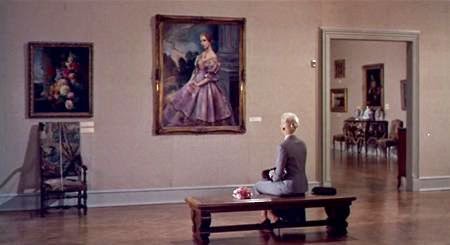
To rehash Vertigo’s familiar plot for reference: John “Scotty” Ferguson is a San Francisco detective who discovers during a rooftop chase that he suffers from acrophobia.  Feeling guilt over the colleague who fell to his death trying to save him, and a sense of inadequacy owing to his spells of vertigo, Scottie quits the force and takes solace with his friend and one-time fiancé Midge.  At a loose end, he finds himself reluctantly employed by old college acquaintance Gavin Elster, now married into a shipping fortune, to follow his wife Madeleine.  Elster claims that his wife has become possessed by a long dead woman – Carlotta Valdes – and wants to know more about Madeleine’s daytime activities before involving doctors.  Following Madeleine, Scotty discovers a woman apparently in a trance, endlessly revisiting a handful of historical San Francisco locations of some particular emotional resonance.  These include Carlotta Valdes’ gravesite at the Mission Dolores (in reality the oldest surviving structure in San Fran), and the art museum at the California Palace of the Legion of Honor where Madeleine studies a portrait of Carlotta.  Madeleine appears to be modelling herself after the figure in the portrait by carrying a bouquet of roses and fashioning the back of her hair into a tight, spiral-like bun. 


Having saved Madeleine from an apparent suicide bid in San Francisco Bay, she and Scottie begin a tentative relationship.  The clock, however, is ticking.  Carlotta Valdes committed suicide at 26, the same age Madeleine is now, and we have a strong sense that Madeleine is melting into Carlotta, and history destined to repeat itself.  Scottie, however, believes that Madeleine can be saved, and the mystery of her apparent possession explained rationally.  Central to solving this mystery are Madeleine’s frequent dreams of an 18th century Spanish monastery whose church has a large bell tower.  This location seems to be the key, the locus around which the spiral turns.  Realizing that these dreams are of a real place, the Mission San Juan Bautisa, Scottie takes her there, hoping that its tangible reality will finally overwhelm her delusions of possession.  However, the opposite results: having made a last avowal of her love, Madeleine runs into the church.  Scottie attempts to follow her up the spiral staircase of the bell tower but is prevented from doing so by attacks of vertigo, and he watches helplessly as Madeleine plunges to her death from the top.  In a sense, we have returned to the beginning of the film, Scottie’s vertigo being the inadvertent cause of somebody’s death, with the toll of grief and guilt more severe this time around as it was the woman he loved.

We now move into the second section of the film.  Scottie, grief-stricken to the point of madness, has become like Madeleine in the first: a ghostly figure, haunted by the past, endlessly returning to San Francisco locations of an obsessive personal significance.  During his wanderings he encounters a brunette, Judy Barton, who bears an uncanny resemblance to Madeleine.  Despite the physical resemblance, Judy is a working girl from Salina, Kansas, who is earthier and more overtly sexual than Madeleine.  In the aforementioned bizarre reveal, the audience is immediately let in on the whole of the plot: Judy was employed by Gavin Elster to impersonate his wife.  The Madeleine Scottie fell in love with was a fiction, the Carlotta Valdes story an elaborate (painfully so, to Vertigo’s detractors) ruse to secure a witness for Madeleine Elster’s supposed suicide, in reality a bait and switch murder carried out by Gavin for cold hard cash.  However, in the midst of maintaining the Madeleine illusion, Judy really did fall in love with Scottie, and so decides to indulge his courtship in the hope that he might fall in love with her for who she really is.  This, however, proves to be painful and demanding, as Scottie is obsessively devoted to the idea of bringing Madeleine back to life to every last detail.  With meticulous care and often tyrannical coercion, he makes Judy over as Madeleine, changing her wardrobe and hair, and finally adding the last crucial detail: the pinned spiral in the hair.  With everything in place, we have one of the cinema’s great raptures: the apotheosis of romantic passion and perverse fetishism as Hitchcock’s camera wheels gracefully around the couple, around the increasingly ambiguous hero who has attained his impious goal, the impervious blonde goddess who represents a symbol of unattainability in life, and becomes literally so in death.

The rapture is short-lived.  A piece of jewellery gives Judy away, Scottie begins to suspect the truth, and we circle back to the bell tower of the Mission San Juan, where Scottie overcomes his acrophobia and forces Judy to confess.  The sudden appearance of a nun startles Judy, causing her to slip over the edge and thus repeat the film’s inescapably tragedy.  Vertigo concludes with Scottie, standing in the bell tower, thrice grief-stricken and guilt-ridden, seemingly trapped in a cycle of reliving the same tragedy, over and over, round and around.


Some of the most common thematic resonances drawn from Vertigo centre on the relationship of Scottie to Madeleine/Judy, and particularly Scottie’s remodelling of the latter into the former in the second part, so I’m going to look at them briefly before exploring the film’s literary and mythical qualities.  In a general sense, Scottie’s fetishistic obsession with Madeleine reminds us of the tendency of people to fall in love with idealizations, images, or narrow ideas of people, rather than with the imperfections, complexities, and day to day variability of the full person.  Love of a strongly romantic or sexual character tends to be the love of an idealization, or a particular ardour engendered by the image.  For the person enthralled by this type of passion, the idealization and the image exist in a realm exalted above the everyday reality in which the object of desire exists as a fully-fleshed out person.  This is the predicament Judy finds herself in; she wants Scottie to love her for her real personality, but he remains obsessively enthralled by the fantasy of Madeleine which she and Gavin Elster created to sucker him.  (Another question raised here relates to identity: did Scottie fall in love in Judy because it was her appearance and personality moulded to become Madeleine, or only with the performance and fantasy of Madeleine?  Are the two – the person and the outward persona adopted – so easily separable?)


Scottie’s recreation of Madeleine has most frequently been associated with the characteristic fetishes and feminine ideals of Hitchcock himself.  The director’s recurring penchant for the reserved, cultivated blonde has been described by Trauffant as “the paradox between the inner fire and the cool surface.”  Hitch himself expressed this duality in somewhat more blunt terms:  “We’re after the drawing-room type, the real ladies who become whores when they’re in the bedroom.”  (Source: Style on Film: Vertigo.) This fairly typical masculine desire to embody Madonna and whore in a single person – outwardly repressed, privately wanton – goes some way towards understanding the duality between Vertigo’s blonde and brunette incarnations of the same woman, and the distinct styles of dress and types of sexuality embodied by Madeleine and Judy Barton.  Madeleine’s characteristic dress is the grey suit – subdued, tight in a manner restrictive rather than sensual, almost severe but elegant in its understated simplicity.  The overall sense of restriction, moderation, and control is completed by the final detail in Scottie’s recreation of Madeleine – the pinning up of the hair at the back.  This clearly represents Hitchcock’s ideal – the sexuality made all the more alluring by being understated, hidden beneath the cold, business-like surface.  In contrast, when we first encounter Judy Barton she wears a lustrously green outfit that emphasizes the natural shape of her body, with (unusually for the time) no bra.  This is the opposite of the restrictive, subdued sexuality represented by Madeleine; in her somewhat forced working gal tones, Novak’s Judy tells Scottie: “I’ve been on blind dates before – to tell you the truth, I’ve been picked up before.”  It’s this earthier, more natural woman that fails to excite Scottie, as he remains enthralled by the fantasy of the artificial Madeleine, the woman who is becoming a painting, a work of art.  In a an interesting piece of life-imitating art, Kim Novak had to be cajoled in the grey suit by her director, just as Judy must be coerced into it by Scottie.

It’s thus not difficult to see Vertigo as a perhaps inadvertent glimpse into the darker corners of its director’s psychology, and a study in general of the subjugation and mistreatment of women.  Although some of the details remain contested, Hitchcock’s preoccupation with his personal blonde ideal seems to have become utterly unhealthy by the time of his relationship with Tippi Hedren.  The intersection between Scottie as an only intermittently sympathetic bully in the second half of Vertigo, and Hitchcock’s apparently obsessive, domineering, and abusive relationship with Tippi Hedren is a fascinating subject, but it is an aspect of Vertigo so well-trodden elsewhere that I’m not going to dwell on it in this essay.


Pygmalion by Jean-Baptiste Regnault, 1786, Musee National du Chateau et des Trianons, wikipedia.


Modern stories which have a certain resonance and archetypal power frequently have analogues with much older myths.  This, at least, is certainly the case with Vertigo.  The most obvious mythic precursor is the story of Orpheus and Eurydice.  Orpheus loses his beloved, and goes into the Underworld to reclaim her from the world of the dead.  His music so charms Persephone that he is allowed to bring Eurydice back to the upper world, with one condition: Orpheus must walk ahead of his bride, and not look back until such time as they have regained the land of the living.  Orpheus is careless, however, and loses his beloved for the second time, this time forever.  Vertigo recapitulates this classic double-punch tragedy: Scottie loses (or appears to lose) Madeleine to death, but then miraculously gets her back.  His own actions, however, ultimately lead to the real and permanent loss of his beloved.  The prohibition against looking back seems particularly apt in relation to Vertigo’s primary theme of the inescapable return of the past in the present.  Scottie’s tragedy is that when he finds Judy, he has the woman he loved, and her love for him was the one thing about Madeleine which wasn’t counterfeit.  But he is haunted by the past, and must look back, first in the re-creation of Madeleine, and then in the return to the Mission San Juan Bautisa, where what was the first time an illusion becomes reality, and he must lose Judy/Madeleine forever.

Scottie also recalls Pygmalion and Oedipus.  Pygmalion was the Cypriot sculptor who carved a woman out of ivory – Galatea – so perfect that he fell in love with her.  Pygmalion prays to Aphrodite for a woman as beautiful as his statue, and upon returning home and kissing Galatea, finds that the dead ivory has become living flesh, and the idealized work of art a real woman.  This myth differs from Vertigo both in its happy ending, and in another crucial element: Scottie falls in love with a work of art which he has not created himself, but which is rather a creation of Gavin Elster’s dramaturgy and Judy Barton’s acting.  Nevertheless, Vertigo reflects and inverts the uncanny transformation of the Pygmalion myth: Madeleine is a real woman in the process of being absorbed into a painting and the chill of history, and Judy a real woman who Scottie cannot love until he transforms into a work of artifice.  Oedipus, on the other hand, is often called literature’s very first detective.  He resembles Scottie in the sense that his tenacity in solving the riddle of his own parentage and identity is ultimately his undoing - cracking the case brings him nothing but profound suffering.

continued shortly